

What if keeping your loved one’s care connected didn’t depend on one family member remembering every instruction? Coordinating care with doctors and family can feel overwhelming when appointment updates, questions, and follow-up tasks are scattered across conversations. It’s understandable to worry that an important detail will be missed, especially when everyone wants to help but isn’t sure who should contact which provider.
A simple, family-led routine can make communication clearer and ease the pressure on the primary caregiver. This guide explains how to share updates with your loved one’s consent, assign communication responsibilities, prepare for appointments, and keep next steps visible. You’ll also learn how non-medical in-home care can support daily routines and help families share relevant observations with the care team, without replacing doctors or clinical guidance.
With a shared plan, family members can contribute in manageable ways, appointments can feel more prepared, and follow-up tasks don’t have to rest on one person’s shoulders. The goal isn’t to track every detail alone, but to create a dependable circle of support around your loved one.
Key Takeaways
- Map the people involved in your loved one’s care and agree who will schedule visits, attend appointments, take notes, and share approved updates.
- Choose one main place to keep care information and tasks, such as a shared calendar, paper notebook, or secure digital document.
- Use a repeatable appointment routine to prepare questions, record guidance, assign follow-up tasks, and review what still needs attention.
- When coordinating care with doctors and family, center your loved one’s preferences and clarify who is authorized to share or receive information.
- Non-medical home care can support daily routines and provide relevant observations for the family, while clinical decisions remain with the medical team.
Why coordinating care with doctors and family matters
Keeping track of appointments, instructions, questions, and updates can place a quiet but constant strain on a family. Information may pass between relatives at different times, while a doctor’s guidance can be difficult to recall once everyone is back home. Coordinating care with doctors and family means creating a reliable way to share relevant information and follow through on agreed tasks, with your loved one’s needs and preferences at the center.
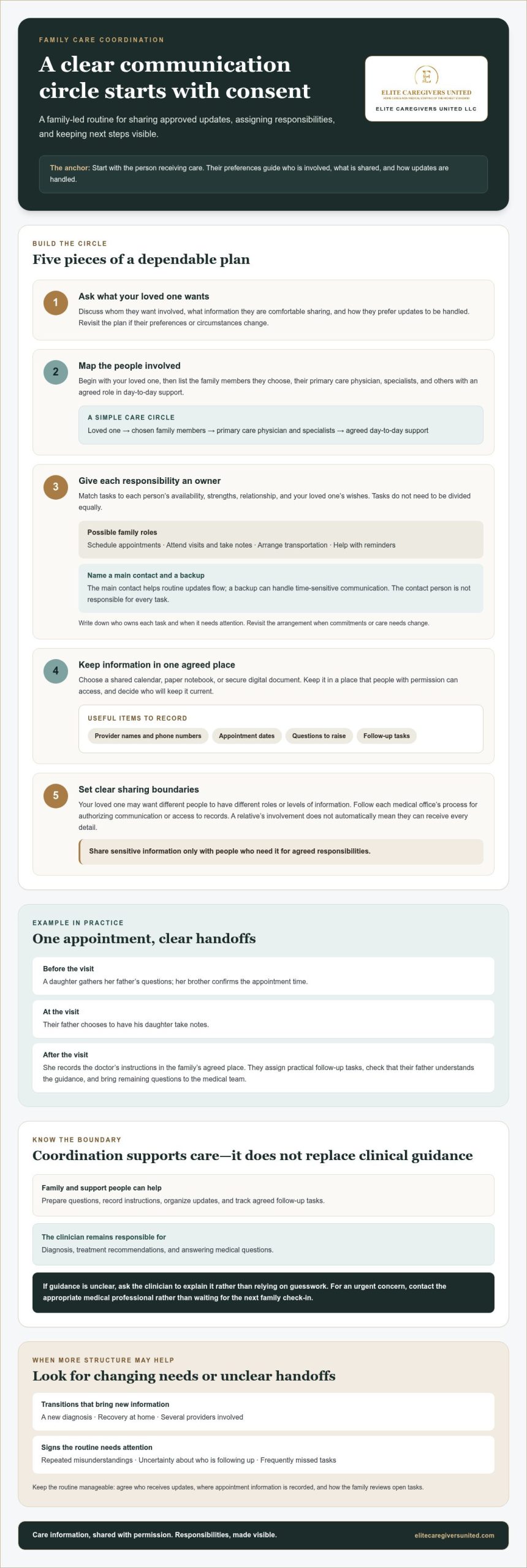
Start with the person receiving care. Ask whom they want involved, what information they’re comfortable sharing, and how they prefer updates to be handled. Let their choices guide the communication circle, and revisit the plan if their preferences or circumstances change. Being related doesn’t automatically mean each person needs the same information or role.
Coordination supports communication; it doesn’t replace medical advice or clinical decisions. Family members can help prepare questions, record instructions, and track when follow-up is due. The doctor or other clinician remains responsible for diagnosis, treatment recommendations, and answering medical questions. If guidance is unclear, the patient or an authorized family participant can ask the clinician to explain it rather than relying on guesswork.
What coordinated care looks like in everyday family life
In practice, coordination gives everyone involved a shared understanding of current priorities, upcoming appointments, and next steps. One person might arrange transportation, another may attend a visit and take notes, and someone else could help with reminders. Tasks don’t need to be divided equally. They should reflect each person’s availability, the patient’s wishes, and what each person can reasonably manage.
For example, before a checkup, a daughter gathers her father’s questions while her brother confirms the appointment time. At the visit, their father chooses to have his daughter take notes. Afterward, she records the doctor’s instructions in the family’s agreed-upon place, then they assign any practical follow-up tasks. The family can check that their father understands what the clinician said and bring any remaining questions to the medical team.
When a more deliberate coordination routine helps
A clearer routine can be especially useful after a new diagnosis, during recovery at home, or when several providers are involved. These transitions may bring new appointments and information to organize. Repeated misunderstandings, uncertainty about who is following up, or frequently missed tasks are signs that the current approach may need more structure.
Keep the routine manageable: agree on who receives updates, where appointment information is recorded, and how the family will review open tasks. This won’t guarantee a particular medical outcome or prevent complications, but it can make responsibilities and questions easier to see. If a concern is urgent or an instruction remains unclear, contact the appropriate medical professional rather than waiting for the next family check-in.
Build a clear communication circle around your loved one
A communication circle gives everyone a clearer view of who is involved and how information should move. Begin with your loved one, then list the family members they choose, their primary care physician, specialists, and anyone else with an agreed role in day-to-day support. This map can make coordinating care with doctors and family more manageable by giving questions and updates a clear path, rather than leaving one person to remember every conversation.
Keep a shared contact and care document in one secure, accessible place. It can include provider names and phone numbers, appointment dates, questions to raise, and follow-up tasks. Choose a location that people with permission can access, and decide who will keep it current. The Agency for Healthcare Research and Quality (AHRQ) on Care Coordination offers broader guidance on organizing care around patients and the people involved in supporting them.
Assign roles without making one person carry everything
Match responsibilities to each person’s availability, relationship, strengths, and your loved one’s preferences. One relative may schedule appointments, another may attend and take notes, while someone else handles transportation or reminders. Agree on a primary family contact for routine updates and name a backup for time-sensitive communication. The contact person helps information flow, but shouldn’t become responsible for every task.
Write down who owns each responsibility and when it needs attention. Revisit the arrangement if someone’s work or family commitments change, or if your loved one’s needs shift. A role that was manageable before may become burdensome later, so adjusting the plan is part of keeping it useful.
Share information with permission and clear boundaries
Ask your loved one whom they want involved and what they’re comfortable sharing with each person. Preferences may differ: one family member might help with appointments, while another receives only general updates. Follow each medical office’s process for authorizing communication or access to records, and don’t assume that a relative’s involvement means they can receive every detail.
Limit sensitive information to people who need it for agreed responsibilities. If a caregiver or other support person is part of the daily routine, clarify what observations your loved one is comfortable having shared and with whom. Clear boundaries support privacy while allowing relevant information to reach the right person.
For families in Orlando, non-medical in-home personal care can support daily routines as part of this wider circle, while family members and clinicians retain their own roles. Explore Orlando non-medical home care support as one way to add practical support at home.
Choose communication methods that keep care information usable
The best system is one your loved one and the people they’ve chosen can use consistently. A shared calendar works well for appointment dates, transportation plans, and reminders, but may not leave enough room for detailed notes. A paper care notebook is easy to bring to visits and can hold questions and written instructions, though relatives may not have it with them or see updates promptly. A secure digital document can give approved family members access from different places and help track open tasks, provided access is limited and everyone knows where the current version lives.
Choose one primary system for family coordination rather than splitting information among text messages, personal emails, notebooks, and calendars. Those other channels can alert someone to an update, but move important details to the central record so the family can find them later. Use medical-office portals, phone lines, or other communication routes according to the patient’s preferences and the provider’s process. Don’t assume a family document is an approved way to send records or clinical questions to a provider.
A useful log records dates, direct observations, questions, and assigned follow-up. Keeping observations separate from interpretations makes it easier to distinguish what happened from what someone thinks it might mean.
What to record before and after appointments
Before a visit, gather the patient’s questions, current concerns, and any recent changes they want to discuss. Whenever possible, capture the person’s own words rather than turning a concern into a diagnosis or conclusion. Note when an observation occurred and who noticed it, so the clinician has clear context.
Afterward, record the clinician’s instructions as accurately as you can and identify who will handle each next step. If something is unclear, mark it as a question rather than filling in the gaps from memory. Keep observations separate from assumptions and secondhand information. For example, write “said they felt dizzy after breakfast” rather than labeling the cause.
How to handle conflicting or unclear instructions
If two instructions seem inconsistent, pause before acting and identify exactly what needs clarification. Contact the relevant clinician’s office using its preferred communication route, and share the wording and source of each instruction. Don’t choose between conflicting directions or change the care plan independently.
Once you receive clarification, record the response, its date, and who will follow through. This gives the family a reliable reference and helps prevent an unanswered question from being repeated as settled guidance. If the response still doesn’t make sense, ask the clinician to explain it more clearly.
A consistent record can make coordinating care with doctors and family easier to sustain, especially when different people help at different times. Keep it factual, current, and focused on information the patient has agreed to share.
Use a repeatable routine for appointments, updates, and follow-up
A steady routine turns a doctor’s visit into clear next steps, rather than a collection of details each person remembers differently. Keep the process simple enough to repeat, and adapt it to your loved one’s preferences and the provider’s instructions. For families coordinating care with doctors and family members, a consistent sequence makes it easier to prepare, capture guidance, and see what still needs attention.
- Prepare. Gather the current medication list and relevant records according to the provider’s instructions. Write down the patient’s main concerns and questions, and decide who will attend or help them participate.
- Attend or arrange participation. Support your loved one in sharing their priorities. If a family member can’t be there, agree beforehand how the patient would like that person involved, such as sharing questions or receiving an update.
- Record. Capture the clinician’s instructions as accurately as possible, including any details that need clarification. Separate what the clinician said from personal observations or assumptions.
- Assign. Identify who will handle each non-clinical next step, such as scheduling a follow-up or requesting records. Give every task an owner and a due date.
- Review. Check what’s complete, what remains open, and which questions need to go back to the appropriate office. Use a family check-in that fits your routine instead of relying on memory.
Prepare for the next doctor’s appointment
Before the visit, follow the provider’s instructions for bringing medication information and records. Keep the question list focused on what matters most to the patient, such as a new concern or uncertainty about the next step. With your loved one’s permission, confirm who will attend, take notes, or help them communicate. If the appointment is part of recovery at home, the article Comprehensive Guide to Home Care After Surgery can provide additional recovery-focused context.
Turn visit instructions into manageable next steps
Before leaving or ending a call, the patient or an authorized family participant can restate the instructions in plain language and ask the clinician to clarify anything uncertain. This gives the clinician a chance to correct a misunderstanding. Afterward, record the agreed next steps and assign practical tasks, such as arranging an appointment or requesting records, to named family members.
Set a check-in time to review progress and gather unresolved questions for the clinician’s office. If instructions appear inconsistent, don’t reconcile them within the family or change the care plan; seek clarification from the appropriate medical professional. For recovery transitions, explore Orlando in-home support that can assist with non-medical daily routines while the medical team guides care decisions.
Add non-medical home care to a family-led coordination plan
A family plan can include practical help at home without shifting clinical responsibilities away from the patient and healthcare professionals. Non-medical personal care may support agreed daily routines and everyday activities, while respite care can give family caregivers time for other responsibilities. The family remains involved in decisions and communication, and clinicians continue to guide medical care.
Make the caregiver’s role clear from the beginning. Talk with your loved one about what support feels comfortable, which routine observations would be useful to share, and who may receive those updates. For example, the family might want to know about a noticeable change in a usual daily routine. Share observations as factual details, not diagnoses or explanations, and respect the person’s preferences and agreed boundaries.
Where an in-home caregiver can support the routine
Daily-living assistance can help put a family’s agreed arrangements into practice at home, while respite support gives family caregivers time away from their usual duties. Families can decide which observations matter to them, who should receive them, and how they want that information shared. For a fuller explanation of this type of support, see Understanding Non-Medical Home Care in Orlando.
These boundaries help everyone understand the caregiver’s role. Caregivers can provide practical support and, when agreed, share relevant observations with the family. They don’t independently coordinate clinical care or interpret medical directions. Their role complements the family’s plan; it doesn’t replace the family’s judgment about who should be involved or the clinician’s expertise.
Keep clinical decisions with the patient and healthcare professionals
Symptoms, treatment questions, and changes to medical instructions belong with the appropriate clinician. A caregiver may help the family notice and communicate an observation within the agreed plan, but doesn’t diagnose, prescribe, or change treatment. This service doesn’t provide skilled nursing. If an instruction is confusing or a new concern arises, the patient or an authorized family participant should contact the medical team for guidance.
A clear support plan can note which daily routines need assistance, what the patient wants shared, and who in the family receives relevant updates. Review it as circumstances or preferences change, keeping medical questions with the clinicians responsible for care. This division of responsibility allows in-home support to be part of the circle without making the caregiver responsible for clinical decisions.
If your family is considering practical support at home, explore Elite Caregivers United’s Orlando care services as you shape a plan that respects your loved one’s preferences and works alongside their medical team.
Let your support plan grow with your loved one
A care plan doesn’t need to be perfect before it can help. Begin with one manageable next step, such as asking your loved one to name who they want involved or setting a time to review open tasks. As needs and family circumstances change, keep making room for the patient’s voice and adjust the practical support around them. Coordinating care with doctors and family is an ongoing effort, not a responsibility one person has to carry alone.
For families in Orlando, Elite Caregivers United provides non-medical personal care through a professional CNA team, including 24/7 caregiving and respite support, with specialized support for recovery and memory-care needs. This care can complement family arrangements while medical questions and treatment decisions remain with healthcare professionals.
Explore compassionate in-home support in Orlando and consider what practical help could make your family’s care routine feel more supported. Small, thoughtful steps can create a steadier path forward for everyone involved.
Frequently Asked Questions
Can a family caregiver speak with a doctor on a loved one’s behalf?
Yes, a family caregiver can help communicate when the loved one wants that support and the medical office follows its authorization process. Ask your loved one what they want shared and whether they’d like you to speak, listen, or take notes. Before the appointment, call the office or review its instructions for approved access. If your loved one can participate, make space for their questions and preferences rather than answering for them.
What should I do if two doctors give different instructions?
Don’t try to reconcile potentially conflicting medical directions on your own. Write down each instruction, who gave it, when it was given, and what needs clarification. Then contact the relevant clinician’s office through its preferred communication route and ask for guidance. If the situation is urgent or changing quickly, follow the urgent-care instructions provided by the treating team or contact local emergency services.
Is care coordination the same as case management?
Not necessarily. Care coordination can describe the practical work of connecting communication and follow-through among people involved in care, while case management may refer to a defined professional role or program. The terms can overlap, so ask the clinician or organization using them what the service includes. For example, clarify whether someone will help arrange appointments, connect services, or provide information, and who remains responsible for each task.
Can a non-medical caregiver coordinate with my loved one’s doctors?
A non-medical caregiver may support daily routines and, with the loved one’s agreement, share relevant observations through the family’s chosen process. For example, a caregiver might report a change in a usual routine to the designated family contact. The caregiver doesn’t replace the patient, family decision-makers, or clinicians, and shouldn’t interpret medical directions or change treatment. Any direct communication or information-sharing must follow the patient’s preferences and the medical office’s procedures.
How can siblings coordinate care when they live in different places?
Agree on one shared update source that each sibling can access, then divide tasks by availability rather than assuming the nearest relative must do everything. One sibling might arrange appointments, while another researches transportation options or keeps a list of questions. When coordinating care with doctors and family across distances, note who owns each task and when it’s due. Include your loved one in decisions and revisit the arrangement if it becomes difficult to maintain.
What information should I bring to a doctor’s appointment?
Follow the medical office’s directions for medication information and records. You can also bring the patient’s main questions, a concise account of relevant changes, and details such as when a concern began or what was happening at the time. For instance, note whether a concern occurs during a particular daily activity. With your loved one’s permission, agree beforehand who will attend or take notes, and ask the clinician to clarify anything the family doesn’t understand.