

Specialized caregiving can make home support more responsive and reassuring. Caregivers can be prepared to support people with Alzheimer’s disease and other dementias. Dementia support for families in Orlando should reflect a loved one’s changing abilities, routines, and safety needs. Support may include companionship, reminders, personal care, and calm reassurance.
It’s understandable to wonder whether home care can meet a loved one’s needs as dementia progresses or whether a memory care community may be more suitable. Familiar surroundings can offer comfort, while the level of supervision and daily assistance needed can help determine which setting fits best.
This article explains what dementia-focused caregiving can involve at home, how home care compares with memory care, and which conditions and stages may be supported. You’ll also learn what to consider when arranging care, so your family can make a thoughtful decision with greater clarity and confidence.
Key Takeaways
- Learn what dementia-focused caregiver preparation can involve and how local support groups can help families feel less alone.
- Use daily assistance needs, safety, and changing abilities to assess whether care at home remains a suitable option.
- Compare the comfort of familiar surroundings with the structured supervision available in a memory care community.
- See how consistent routines and thoughtful reassurance may support a person with dementia at home.
- Explore how respite care and personal care support can give family caregivers time to rest while their loved one receives help.
Are caregivers specifically trained for Alzheimer’s and dementia?
Caregivers can provide support for people with Alzheimer’s disease and other forms of dementia. This care may involve responding to communication changes, offering reassurance, and following routines that support comfort. When planning care, families can share daily needs, familiar approaches, and activities that help their loved one feel at ease.
Personalized care planning starts with practical details. Share the person’s preferred name, usual schedule, food preferences, mobility needs, and responses to change. For example, if a sudden change of activity causes distress, caregivers can use familiar cues and a calm transition. These details help make support more consistent.
Unpaid family members and friends also need emotional support. The Alzheimer’s Association holds caregiver support groups across 43 counties in Central and North Florida. These groups give caregivers a place to talk with others facing similar responsibilities and learn ways to manage the daily demands of dementia care.
In Orlando, Reeves United Methodist Church holds an early-stage group on the first and third Monday of every month at 10:00 a.m. Congregation of Reform Judaism meets on the second Thursday of every month at 1:00 p.m. Holy Family Catholic Church lists 407-760-2304 and 407-913-0083 as support-group contacts. Call or email a group contact before attending to verify its listed meeting details.
The Alzheimer’s Association dementia Helpline is 800.272.3900. Contact it for dementia-related guidance; local support groups provide scheduled meetings rather than crisis response. If a situation requires immediate emergency assistance, use the appropriate emergency channel.
Local community resources can support daily life beyond caregiver meetings. Transportation and meal programs may help a person who lives independently but needs assistance. Some adult day centers offer activities and supervision, and some provide pickup and drop-off at home. Florida’s Elder Helpline, 1-800-96-ELDER (800-963-5337), can help families find a local Aging and Disability Resource Center.
Florida Statewide Medicaid Managed Care Long Term Care plans may provide caregiver respite, training, and in-home services to enrolled members when the member’s long-term care plan approves them. Families can ask about these supports as part of the care-planning process. Florida’s Alzheimer’s Disease Initiative also provides respite for caregivers of adults age 18 and older with probable Alzheimer’s disease or a related memory disorder. Its extended respite care may last up to 30 days, with services provided through 11 Area Agencies on Aging.
To organize support, write down the person’s routines, care needs, and emergency contacts. Then identify the family’s most immediate need, such as respite or help with daily activities. A clear plan helps caregivers share responsibilities while preserving meaningful time together.
Can a Person with Dementia be Cared for at Home?
Home care may suit a person whose needs can be safely supported in familiar surroundings. Adult day centers in Orlando may offer daytime activities and supervision, with some providing home pickup and drop-off. At home, support can include companionship, reminders, meals, personal care, and supervision.
Deciding on Care at Home
Consider how dementia affects memory, reasoning, behavior, and everyday tasks. Start by noting which activities the person manages independently and where confusion or safety concerns arise. For example, difficulty preparing meals may mean they need help with food and routine. Consider whether family members can reliably cover needs throughout the day and overnight.
Home Care and Home Health Care
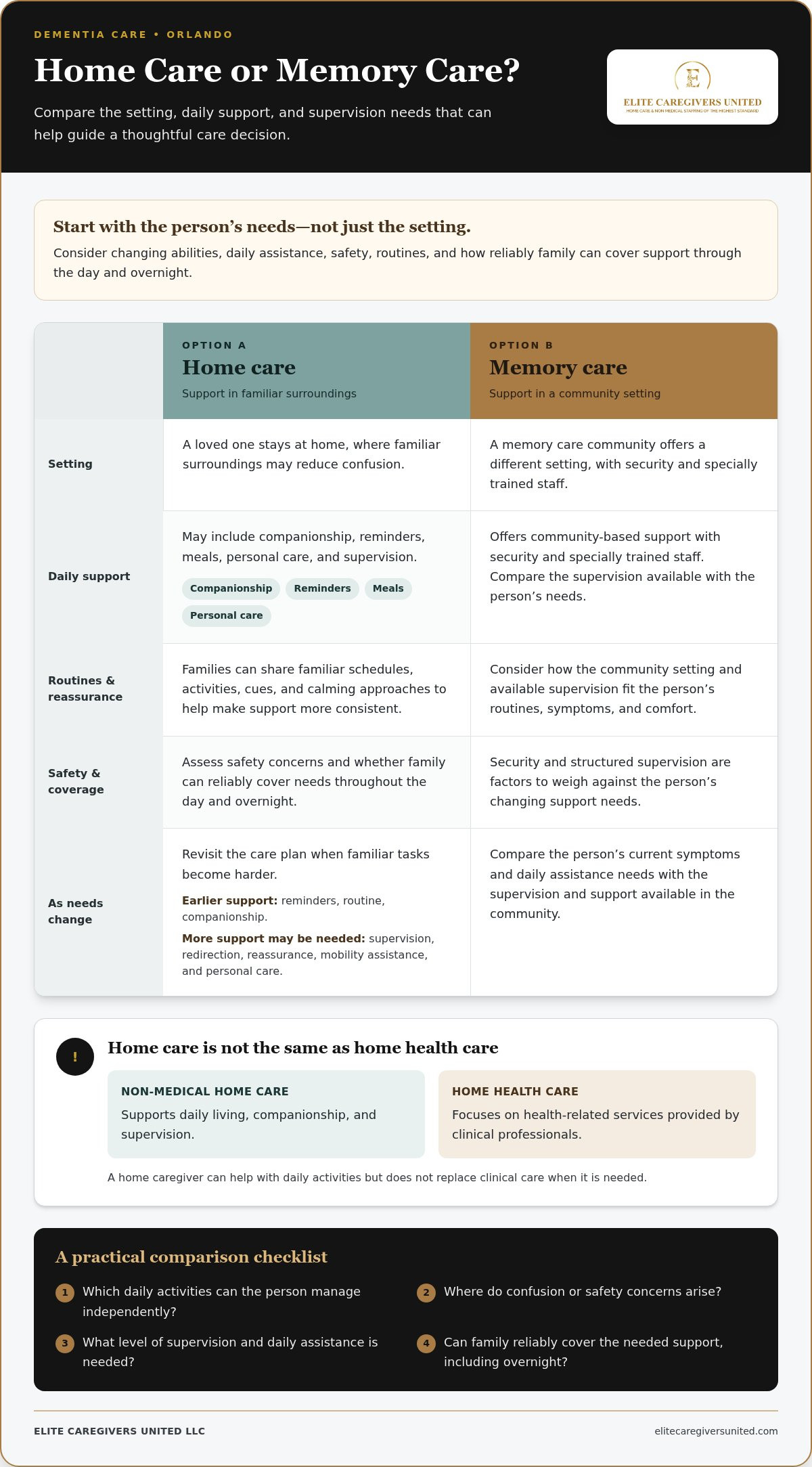
Non-medical home care supports daily living, companionship, and supervision. Home health care focuses on health-related services provided by clinical professionals. Because these forms of care serve different purposes, identify whether the immediate need is help with a routine or a health service. A home caregiver can support daily activities but doesn’t replace clinical care when it’s needed.
Daily Living and Personal Care
Activities of daily living can include dressing, bathing, eating, and moving around the home. A caregiver can offer step-by-step help while respecting privacy and allowing time for the person to participate. For example, laying out clothing in sequence may make getting dressed easier. Compassionate support can also include meal preparation and medication reminders.
Adjusting Care Plans Over Time
Dementia care needs can change as the disease progresses, so revisit the plan when familiar tasks become harder. Early support may focus on reminders, routine, and companionship. Later, the person may need more supervision, redirection, reassurance, mobility assistance, and personal care. Record changes in daily abilities and share clear examples with family members involved in care.
At home, consistent routines can help make support more predictable. A written plan might note preferred activities, mealtimes, and calming responses when confusion arises. Families can use these details to coordinate care and notice when daily needs have shifted. For those considering dementia care at home, personal care and steady companionship can be part of a non-medical support approach.
Home care compared with memory care facilities
Home care and memory care communities provide different settings for supporting someone with memory loss. Familiar surroundings may reduce confusion, while a memory care community provides security and specially trained staff. Compare the person’s symptoms, supervision needs, daily routines, and the support available to family caregivers.
At home, care can be organized around the person’s schedule and familiar belongings. This may suit someone who benefits from a known environment and needs help with selected activities. A memory care community offers a more structured setting, which may be relevant when safety concerns or supervision needs increase. The key question is whether the setting can meet the person’s needs throughout the day and night.
Caregiver preparation matters in either setting. Memory care communities have specially trained staff. Families can look for respectful communication, patience during confusion, and person-centered routines. For home support, describe specific symptoms and helpful responses, such as offering one clear direction at a time or using a familiar activity to ease a transition. These details make care more responsive than a general description of memory loss.
In-home memory care costs depend on the amount and type of assistance required. Consider how many hours of support are needed, whether care must cover nights, and whether the person needs help with personal care, meals, supervision, or mobility. A long-term care facility may be more cost-effective when someone needs round-the-clock support. Compare the full schedule of assistance with what each setting provides, rather than comparing a short visit with continuous coverage.
A diagnosis can help clarify the source of memory changes. Floridians of any age suspected of having a memory disorder may request a diagnostic evaluation from a Memory Disorder Clinic. Before an evaluation, families can note changes in memory, behavior, and everyday abilities. Clear examples, such as repeated difficulty following a familiar route, help explain symptoms and their effect on daily life.
A person-centered approach puts preferences and abilities at the heart of decisions. Record the person’s preferred routines, communication style, and calming activities, then share those details with caregivers or facility staff. For example, a familiar morning sequence may help preserve independence while allowing assistance where needed. Revisit the plan when symptoms change, safety needs grow, or the current setting no longer supports daily comfort.
For a practical comparison, list the support needed at home, the hours family members can provide, and the level of supervision required. If the person needs round-the-clock coverage, include a long-term care facility in the decision. If their needs remain manageable at home, familiar routines and tailored assistance may make home care suitable.
Benefits of familiar home routines and surroundings
Familiar rooms, belongings, and daily habits can reduce agitation and confusion for someone with dementia. Consistent routines can also provide a sense of security, helping the person anticipate ordinary activities such as breakfast or an afternoon walk.
Start an in-home assessment by recording the person’s usual schedule, strengths, and daily challenges. Walk through the home together and note where support may be needed, such as preparing meals, using the bathroom, or moving between rooms. Include family members who provide care, as they can describe which approaches bring comfort and which changes cause distress.
Make the routine practical rather than rigid. A written plan might include a familiar breakfast, a quiet rest period, and an enjoyable activity, while allowing flexibility when energy or attention changes. Keep frequently used items in consistent places, such as placing a coat beside the same doorway. Familiar cues can help the person stay involved in daily life.
Florida families should also plan legal and healthcare decisions after a dementia diagnosis. A durable power of attorney can assign financial management responsibilities, while an advance directive can name a healthcare decision-maker and describe preferred end-of-life treatment. Prepare a will or trust while the person receiving care can still make decisions.
For home safety, identify hazards room by room and consider what supervision daily activities require. For example, store cleaning products securely, clear walking paths, and keep commonly used items easy to reach. Make emergency contacts accessible to family members and caregivers. Review the plan after changes in mobility, wandering risk, or the ability to manage household tasks.
In-home respite can give family caregivers time away while a person remains in familiar surroundings. Florida’s Alzheimer’s Disease Initiative offers extended respite care for up to 30 days through 11 Area Agencies on Aging. It serves caregivers of adults age 18 and older diagnosed with probable Alzheimer’s disease or a related memory disorder. Families exploring respite may also encounter the RELIEF Program.
Before arranging respite, write down the person’s routines, communication preferences, and comfort strategies. Include practical examples, such as offering a familiar snack or giving one instruction at a time. Share this guide with the caregiver to help keep daily support consistent. Planned time away can help family caregivers return with more energy and attention.
Conditions supported, including Alzheimer’s and different types of dementia
Alzheimer’s disease is the most common form of dementia, but families may encounter other dementia diagnoses as well. A diagnosis provides important context, while day-to-day support should also reflect the person’s abilities, behavior, and changing needs. Two people with the same diagnosis may need different help with familiar activities.
Consider what the person can do comfortably and where support is needed. One individual may need reminders to follow a daily routine; another may need help with personal care, meals, or supervision. Memory changes, difficulty reasoning, and shifts in behavior can affect these tasks in different ways. Recording specific examples helps families describe practical needs rather than relying on a diagnosis alone.
For example, note whether a loved one forgets steps while preparing a familiar meal, becomes distressed when a routine changes, or needs help choosing clothes. Include what happened beforehand and which response helped restore comfort. These details can guide a personalized home care approach, whether the person lives with Alzheimer’s disease or another form of dementia.
Memory care needs can change over time. Someone who once managed dressing independently may later need gentle prompting or hands-on assistance. Families can review the care plan when daily tasks become harder, behavior changes, or supervision needs increase. A useful plan describes current abilities, preferred routines, communication approaches, and the support needed for personal care.
Specialized dementia support meets the person where they are. Caregivers can use clear, calm communication, allow extra time for responses, and adapt activities to the person’s interests and abilities. For instance, if a multi-step household task becomes frustrating, breaking it into simpler steps may help the person stay involved. Consistency matters, but the plan should evolve as needs change.
Families in Orlando can use these observations to describe what assistance would make home life more manageable. Write down the person’s diagnosis, daily strengths, specific challenges, and helpful responses. Share those notes with family members involved in care so support stays consistent across daily routines. This practical picture helps distinguish a condition’s label from the care the person actually needs.
If Alzheimer’s or another dementia diagnosis is prompting new care questions, explore specialized dementia care support and consider how personalized assistance could fit your family’s routines.
Elite Caregivers United: Respite Care
Elite Caregivers United offers respite care for families who need support while resting, managing responsibilities, or attending appointments. For someone living with dementia, familiar routines and clear guidance can help make a caregiver’s time away more settled. The agency also provides personal care through its CNA team, supporting everyday needs with attentive, respectful assistance.
Consider respite when caregiving leaves little room for rest or other family responsibilities. Sharing useful details, such as preferred routines, communication approaches, and personal care needs, can help guide support. Elite Caregivers United also provides surgery recovery and post-hospitalization care, as well as cosmetic surgery recovery.
Contact Elite Caregivers United to discuss respite or personal care support for your family.
Take the Next Step Toward Steady Support
Care decisions can begin with one manageable step: identify which parts of the day feel hardest for your family, then consider what assistance would make them easier. For families seeking dementia support in Orlando, a thoughtful conversation can connect daily needs with a practical plan that respects a loved one’s preferences.
Elite Caregivers United offers Respite Care, Personal Care Services through a CNA team, and Surgery Recovery & Post-Hospitalization Care. These services meet different needs, from giving family caregivers time to rest to helping with personal routines or recovery at home. Choosing support does not mean stepping away from your relationship; it can create more room for meaningful time together.
Share the routines, concerns, and caregiving tasks your family would like help managing. Contact Elite Caregivers United to discuss a supportive next step for your household. A clear plan can help your family move forward with greater confidence, one day at a time.
Frequently Asked Questions
Can care be provided 24 hours a day or overnight?
Yes, Elite Caregivers United offers 24-hour home care, including overnight support. The company also states that it provides 24/7 availability, same-day scheduling, and emergency support. Families can describe the hours when supervision is needed, such as overnight when a loved one wakes disoriented or tries to leave home. Sharing those patterns helps clarify what kind of coverage may fit the household’s needs.
Can dementia care services be adjusted as the condition progresses?
Yes, care can be tailored as a person’s abilities and daily support needs change. A useful review starts with specific changes, such as needing more reminders, help with dressing, or closer supervision during meals. Elite Caregivers United creates personalized care plans after a home assessment. Families can share updated observations so the plan reflects current routines and needs, not an outdated picture of the person’s abilities.
Do you provide specialized care for different types of dementia?
Elite Caregivers United provides Alzheimer’s & Dementia Care, shaped around the person’s condition and everyday needs. Families can share the diagnosis, communication preferences, routines, and activities their loved one enjoys. For example, note whether music or a familiar task helps during transitions. The company also provides Parkinson’s Disease Home Care, a distinct offering for people living with Parkinson’s disease.
Does My Loved One Have Dementia?
Memory or behavior changes alone cannot establish whether someone has dementia. Write down examples, such as repeating questions, getting lost on a familiar route, or struggling with a usual household task, and share them during an evaluation. Floridians of any age suspected of having a memory disorder may request a diagnostic evaluation from a Memory Disorder Clinic. A written timeline can help explain when changes began and how they affect daily life.
How do you handle the challenging behaviors associated with dementia?
Start by considering what may be behind the behavior, such as fatigue, discomfort, noise, or a confusing task. Speak calmly, use short phrases, and offer one simple choice, such as sitting in a quiet room or listening to familiar music. Briefly record what happened before and after the distress. These observations can help family members share patterns and helpful responses when arranging dementia care.
How do you help families understand and cope with dementia?
Families can build understanding by learning how changes affect everyday tasks, then sharing caregiving responsibilities in clear, manageable ways. Try a simple weekly plan that identifies who handles meals, appointments, and time away for rest. The Alzheimer’s Association offers caregiver resources, while conversations with relatives can help everyone use familiar language and consistent routines. Writing down questions before a family discussion can make concerns easier to address.
What does dementia care include near me in Orlando, FL?
In Orlando, dementia care at home may include companionship, personal care, routine support, meal preparation, and supervision, depending on the person’s needs. Elite Caregivers United provides non-medical Alzheimer’s & Dementia Care and Personal Care Services through a CNA team. Its 24-hour home care and stated 24/7 availability may help families seeking dementia support for families in Orlando, including overnight needs. Home care doesn’t replace skilled clinical services.
What dementia support groups are available for families in Orlando, Florida?
The Alzheimer’s Association offers caregiver support groups in Central and North Florida, giving family members a place to connect with others facing similar challenges. Counsel for Caregivers seminars are free and open to the public, covering topics such as fall prevention at home, arthritis pain reduction, and insurance policies. Families can use a seminar to learn practical planning ideas, then discuss which steps suit their loved one’s home routine.