
What if a clean caregiver background check answered only part of the question your family is asking? When you’re arranging support at home, it’s natural to want clear reassurance before welcoming someone into a loved one’s daily life. Understanding background checks for in-home caregivers Florida families may encounter can help you distinguish fingerprint-based screening from a name-based search and keep its limits in perspective.
Florida requires Level 2 fingerprint-based screening for home care personnel with direct access to patients. This screening checks state and national criminal history records, with results handled through the state’s screening systems. A record can’t show how a caregiver will communicate, respond to individual needs, or build a respectful relationship, and a clear result isn’t a guarantee of safety. This guide explains which rules may apply to different roles, what screening information can and can’t tell you, and how to use a practical checklist to assess caregiver fit and oversight. With a clearer understanding of the process, you can make care decisions with realistic expectations.
Key Takeaways
- Use background checks for in-home caregivers Florida as one part of assessing trust, not as a guarantee of future conduct.
- Understand how Florida’s screening systems fit together and why requirements can differ by caregiver role.
- Compare what identity checks, criminal-record searches, and fingerprint-based screenings may reveal, as well as what they can’t establish.
- Use a practical checklist to clarify who conducted screening, what it covered, and how the caregiver’s duties and supervision are defined.
- Consider screening alongside care needs, communication, and caregiver fit when planning support in Orlando.
Why Florida Families Check In-Home Caregiver Backgrounds
Inviting someone into a family member’s home is a personal decision. A caregiver may help with bathing, dressing, meals, mobility, or companionship, becoming part of routines that are private and familiar. It makes sense to want clear information before care begins, while recognizing that screening is just one part of choosing support that respects your loved one’s dignity and needs.
A background check searches specified records. It is not a promise about how someone will act in the future. The Background check overview describes its general use in employment screening, but the details matter: results reflect the records searched, the identity information used to match them, and when the search took place. A clear result cannot predict every future action or replace communication and appropriate oversight.
For families researching background checks for in-home caregivers Florida requirements can depend on the provider, the position, and how care is arranged. Florida identifies Level 2 fingerprint-based screening for home health and home care personnel with direct access to patients. Don’t assume every person described as a caregiver falls into the same category. Consult current AHCA and Clearinghouse guidance for the specific role and arrangement.
What a caregiver background check can, and cannot, tell a family
A report can provide information about the records included in that particular search. It can’t establish a person’s character, judgment, or compatibility with your family. The search’s scope matters: a name-based search and a fingerprint-based screening are not interchangeable. Identity matching matters too, since incorrect or incomplete identifying details can complicate how a result is interpreted.
Timing is another consideration. A report reflects information available when the check was conducted, not a permanent guarantee. Treat it as one part of a broader conversation about experience, responsibilities, communication, and the care recipient’s comfort.
Why the Florida care arrangement matters
With agency-managed care, the caregiver is employed through an organization. With direct hiring, the family engages the caregiver itself. These arrangements affect who coordinates hiring and which responsibilities apply, but neither automatically guarantees safety. Screening obligations may differ by provider type and position, so clarify which rules apply rather than relying on the job title alone.
Before care starts, seek a plain-language explanation of the screening’s scope and how it relates to the caregiver’s assigned duties. Discuss who provides direction, how concerns are communicated, and what support your loved one needs, such as help with personal care or memory-related routines. These questions keep the focus on informed, respectful care.
- Clarify whether the arrangement is agency-managed or directly hired.
- Identify the caregiver’s role and duties, then check which Florida screening requirements apply.
- Consider screening alongside communication, supervision, and your loved one’s individual needs.
How Florida Caregiver Screening and the AHCA Clearinghouse Fit Together
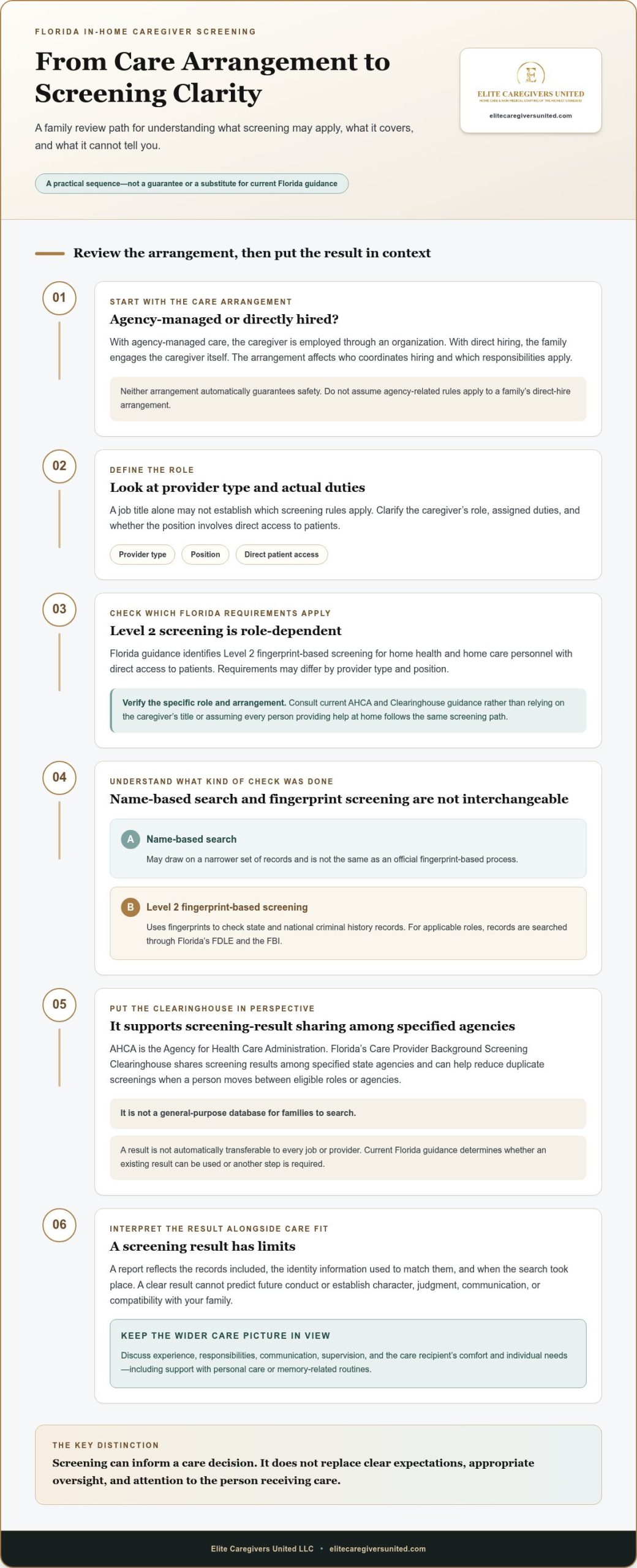
Florida’s screening system can help families understand whether a caregiver’s role falls under a state-required process, but the agency name alone doesn’t answer that question. AHCA is the Agency for Health Care Administration. Its Florida Care Provider Background Screening Clearinghouse shares screening results among specified state agencies, helping reduce duplicate screenings when a person moves between eligible roles or agencies.
The Clearinghouse isn’t a general-purpose database for families to search, and it doesn’t mean every person who provides help at home follows the same screening path. For background checks for in-home caregivers Florida families should start with the care provider type and the caregiver’s actual duties, then consult current AHCA guidance to understand which requirements apply.
What families should know about AHCA and the Clearinghouse
Florida guidance identifies Level 2 screening for home health and home care personnel with direct access to patients. A Level 2 screening uses fingerprints to check state and national criminal history records. This differs from a name-based online search, which may draw on a narrower set of records and isn’t the same as an official fingerprint-based process.
This distinction is useful when discussing care arranged through an agency. Clarify what the screening information represents and whether the role is covered by the applicable state process. A caregiver’s title by itself may not establish the answer. The provider category and position matter. Families hiring directly should not assume agency-related rules automatically apply to their arrangement.
When fingerprint-based screening may apply
For roles that require Level 2 screening, fingerprints are used to search records maintained through Florida’s FDLE and the FBI. The Clearinghouse can support sharing among participating agencies, but that doesn’t mean every result is transferable to every job or provider. Current Florida guidance determines whether the new role is eligible to use an existing result or requires another step.
Exemptions, eligibility, transfer rules, and renewal or rescreening requirements can depend on the circumstances and may change. Don’t treat a past check as permanently valid. Confirm what applies to the caregiver’s specific role and whether the screening remains current under the relevant rules.
To follow the process, identify the provider and job category, consult current AHCA screening guidance, and clarify whether the applicable check is fingerprint-based or another type of search. Then understand what the result covers and what it does not. This distinguishes an official screening result from a generic web search and helps families ask focused questions without expecting a record check to resolve every concern.
Screening is one part of a thoughtful care plan. Families in Orlando exploring personal care or respite support can learn about in-home care from Elite Caregivers United, a Florida-licensed agency with a professional CNA team.
Comparing Florida Caregiver Background Checks: What Each One Covers
Different screening steps answer different questions. An identity check helps establish who a person is. A criminal-record search looks for records within its scope. A fingerprint-based screening uses biometric information to support record matching. Optional employment-screening components, such as reference or driving-history checks, may add context when they relate to the caregiver’s duties. These checks aren’t interchangeable or proof of overall suitability.
For families comparing background checks for in-home caregivers Florida requirements, the care role and applicable screening pathway matter. The table below is a starting point for understanding what a check may show and what still calls for a separate conversation.
| Check type | What it may cover | What it cannot establish and when relevance varies |
|---|---|---|
| Identity verification | Whether identifying details, such as a person’s name and other submitted information, correspond with the individual being considered. | It doesn’t reveal conduct or establish the completeness of a records search. Accurate identity matching matters to every later check. |
| Name-based criminal-record search | Criminal-record information returned by the particular search using identifying details. Coverage depends on the search process and jurisdictions included. | It may not cover the same records as a fingerprint-based process, and a result shouldn’t be assumed to represent every jurisdiction or record. It isn’t automatically equivalent to an official screening required for a particular role. |
| Fingerprint-based screening | For Florida Level 2 screening, fingerprints are used to search state and national criminal history records through the official process. | It reports records within the applicable screening scope. It can’t predict future conduct or establish how a caregiver will interact with a loved one. Whether it applies depends on the provider category and position. |
| Role-specific or employment checks | Depending on the arrangement and duties, these may include driving history, employment history, or references. A driving-record check is most relevant when transportation is part of the role. | These checks don’t replace criminal-record screening where an official process applies. References and work history offer context, not a definitive account of future care. |
Fingerprint-based screening versus a name-based records search
A name-based search matches records using identifying details. Fingerprint-based screening uses fingerprints to support matching against criminal history records. Neither method is infallible, and scope depends on the process, jurisdictions, and requirements that apply. A commercial search may offer useful information, but families shouldn’t assume it substitutes for Florida’s required screening pathway.
Other checks and the limits of a report
Consider optional checks in light of actual duties. If a caregiver will drive a loved one to appointments, driving history may be relevant. If not, it may offer little insight into the care itself. Interviews and references can help families understand communication style and work experience, while official searches address records. No single screening component answers every safety question; each contributes a different piece of information.
A Florida Family Checklist for Reviewing Caregiver Screening
A screening record is easier to interpret when you know who arranged it, what process was used, and how it relates to the caregiver’s actual responsibilities. Use this checklist to guide a calm, practical conversation. You don’t need to collect more personal information than necessary to understand the arrangement.
Questions that make screening information easier to interpret
- Identify the hiring arrangement and role. Clarify whether the caregiver is employed by an agency or hired directly, and describe the position and expected duties. Florida screening requirements can vary by provider type and role, so don’t assume one rule applies to every person called a caregiver.
- Ask which screening process applies. Find out whether the process is an official fingerprint-based screening, a name-based records search, or another check. If the role is subject to a Florida requirement, use current AHCA and Clearinghouse guidance to understand the applicable pathway.
- Clarify the date and scope. Ask when the screening was completed, what records or jurisdictions it covered, and what limitations to keep in mind. A report only speaks to the search that was conducted. Don’t treat an unspecified “background check” as a complete description.
- Understand identity matching and related qualifications. Learn how the information was matched to the individual and consider relevant training, experience, or job qualifications separately from criminal-record results. Each answers a different question.
- Agree on duties and oversight. Discuss who provides direction, what tasks are expected, how family updates will work, and whom to contact with concerns. Be specific about needs such as mobility assistance, personal care, memory support, or transportation.
Keep sensitive information private. Avoid requesting or retaining unnecessary personal records, and don’t share screening documents beyond people who need them to make or manage the care arrangement. If documents are provided, handle and store them thoughtfully. Questions about legal eligibility, exemptions, or how a screening rule applies are different from practical hiring questions. Consult current Florida agency guidance or a qualified legal professional for interpretation.
Look beyond the report to day-to-day care fit
Notice how the caregiver listens, explains routines, and responds to the care recipient’s preferences. Relevant experience can help, but the family should also consider whether communication feels respectful and whether the person receiving care seems comfortable. A thoughtful plan makes duties clear while protecting dignity and privacy and adapting to changing needs.
Careful hiring brings records, role fit, and ongoing communication together; no report can replace attentive oversight. Families seeking personal care or respite support in Orlando can explore care options with Elite Caregivers United, a Florida-licensed home care agency with a professional CNA team.
Choosing In-Home Care in Orlando After Reviewing Screening
Screening can inform a care decision, but the day-to-day arrangement deserves equal attention. A clear plan helps everyone understand what support is needed, which duties the caregiver will handle, how updates will be shared, and what the family expects. As you review background checks for in-home caregivers Florida families may encounter, consider the whole picture: records, care needs, communication, and respectful fit.
Match the care arrangement to the person’s needs
Start by separating help with daily living from skilled nursing or clinical procedures. Non-medical home care can support routines such as personal care and offer respite for family caregivers, while clinical needs may call for a different type of professional. For surgery-related daily support and recovery at home, explore home care after surgery. For ongoing assistance with everyday routines, learn about non-medical home care in Orlando.
Elite Caregivers United LLC is a Florida-licensed, Orlando-based home care agency with a professional CNA team. Its non-medical support includes personal care, respite, recovery support, memory-care support, and 24-hour home care. These services support care at home and do not replace skilled nursing or clinical procedures.
Plan supportive care in Orlando with confidence
Before discussing an arrangement, write down what a typical day looks like and where help would make the greatest difference. Note preferred routines, communication needs, mobility or personal-care assistance, and any concerns the care recipient has about receiving support. Decide who in the family will coordinate updates and how questions or changes in needs should be communicated. Specific expectations make it easier to assess whether a proposed care plan fits.
For continuous assistance at home, review information about 24-hour home care in Orlando. Screening records can be part of your planning, but they don’t replace clear duties, communication, or attention to how your loved one feels with the caregiver. A supportive arrangement should be shaped around the person, not just the paperwork.
If your family is considering in-home support in Orlando, share your loved one’s needs, daily routines, and priorities with the Elite Caregivers United team to discuss care options. A thoughtful conversation can help you take the next step with greater clarity and realistic expectations.
Take the Next Step Toward a Thoughtful Care Plan
Choosing support is not a one-time decision. As routines or needs change, revisit whether the care plan remains clear, responsibilities are understood, and your loved one feels comfortable expressing preferences. Open communication gives everyone a way to adjust thoughtfully instead of relying on a screening result to answer every question over time.
Use your notes about background checks for in-home caregivers Florida as a starting point for a broader conversation about the support that would make daily life more manageable. You don’t need every detail settled before taking that step. Sharing what matters most to your family can guide a practical discussion about care options.
Talk with our Orlando care team about the support your family needs. Share your priorities to start a thoughtful conversation about a care plan.
Frequently Asked Questions
Do all in-home caregivers in Florida need Level 2 background screening?
No, families shouldn’t assume one screening rule covers every in-home caregiver. Requirements can depend on the provider category, the caregiver’s position, and whether care is arranged through an agency or hired directly. For example, a role involving direct patient access may be treated differently from another household-help position. Consult current AHCA guidance for the specific arrangement, and seek qualified advice if the rule’s application remains unclear.
What is the Florida Care Provider Background Screening Clearinghouse?
It’s a Florida system used to support sharing screening results among specified state agencies for eligible care-provider screening pathways. Its relevance depends on the provider category and position, so it shouldn’t be viewed as a complete personal-history lookup tool for families. If a care arrangement involves a provider that uses the Clearinghouse, consult current AHCA information to understand applicable categories, access, and how the system relates to that role.
Can a caregiver use the same Florida background screening for a new employer?
Possibly, but families shouldn’t assume an earlier screening automatically carries over. Whether a prior result can be used may depend on the caregiver’s eligibility, the new employer’s participation, the position, and current Clearinghouse rules. For instance, moving between covered provider roles may raise different questions than moving into a direct-hire household arrangement. Check current AHCA guidance for the specific situation, including transfer or exemption requirements.
How often are in-home caregiver background checks repeated in Florida?
There isn’t one interval families should apply to every caregiver without first identifying the relevant rule. Repeat-screening timing can depend on provider requirements and the role, while an employer may also have its own policies. A screening completed at hiring and a later renewal are separate events to clarify. Review current Florida requirements for the care arrangement rather than assuming a past check remains current indefinitely.
Can a family run a background check on a caregiver they hire directly?
A family may consider screening for a directly hired caregiver, but the process should respect privacy and follow applicable rules. Consent, handling personal information, and consumer-reporting requirements can matter, particularly if a report is obtained from a third party and used in a hiring decision. Before taking action, verify relevant federal and Florida requirements or seek qualified legal guidance. Avoid gathering or circulating sensitive records that aren’t needed.
Does a clean background check guarantee that an in-home caregiver is safe?
No. A report can’t guarantee future conduct, and it may not include every record or answer every question about a person’s judgment and caregiving approach. Screening is one useful part of making an informed choice, alongside clear duties, relevant experience, respectful communication, and appropriate oversight. For example, a conversation about how a caregiver handles routine changes can reveal practical information that a records search cannot provide.
How long does a Florida caregiver background check take?
Processing time varies with the pathway used, fingerprint submission, record availability, and administrative processing. A delay doesn’t by itself explain the result, and completion isn’t the same as deciding whether someone is a good fit for a particular care arrangement. If timing affects a planned start date, consult the official process relevant to the role for current estimates, then plan care transitions without relying on an assumed turnaround.