

At breakfast, holding a cup of coffee can turn an ordinary moment into a frustrating one when tremors make the task difficult. As a caregiver for parent with Parkinson’s tremors, you may want to step in quickly while also wondering how to help without taking away your parent’s independence. The aim is to make daily life safer and calmer while respecting your parent’s choices and abilities.
It’s understandable if the right approach isn’t always clear, especially as care needs grow and family responsibilities become harder to manage alone. You don’t have to do everything yourself. Accepting help doesn’t mean stepping away from your parent’s life.
This guide offers practical ways to support everyday routines, from meals and dressing to making the home routine more comfortable. You’ll also learn how to offer help with dignity, plan together as a family, and consider when non-medical home care or respite support could complement the care you provide. The goal is a steadier routine that keeps your parent involved and gives your family more room to breathe.
Key Takeaways
- Tremors can affect everyday tasks differently from person to person, so tailor support to your parent’s abilities and preferences.
- A caregiver for parent with Parkinson’s tremors can assist with daily routines and companionship, but diagnosis, medication changes, and clinical treatment belong with a clinician.
- Use a simple, respectful approach: ask what help is welcome, observe the task, offer agreed assistance, and check how it feels.
- Compare family help, respite care, and ongoing home care to find a sustainable arrangement that respects your parent’s wishes and your family’s capacity.
- Orlando families can receive Parkinson’s disease home care from Elite Caregivers United, with non-medical support complementing clinician-led care.
How Parkinson’s Tremors Can Change Everyday Life at Home
A tremor is an involuntary, rhythmic shaking that can affect part of the body, often the hands. In Parkinson’s, tremor is one possible movement symptom. It differs from changes such as stiffness or slowness, though a person may experience more than one kind of movement change. The overview of Parkinson’s disease describes tremor among the condition’s motor symptoms. Its pattern, timing, and effect on daily life can vary, so tremor alone doesn’t tell a family exactly what support someone needs.
Tremor-aware caregiving means adapting everyday assistance to a person’s movements and preferences, while supporting comfort and independence without attempting to treat Parkinson’s disease. If you’re a caregiver for parent with Parkinson’s tremors, notice which tasks feel difficult and ask before stepping in. That’s a useful place to begin.
Which everyday activities may feel harder when tremors are present?
A hand tremor may make it harder to hold a utensil, bring a drink to the table, fasten small buttons, write a note, or pick up coins and keys. Your parent might take longer, need a different approach, or find a task harder at a particular time. Their experience may differ from one day or activity to the next.
Taking longer doesn’t automatically mean being unable to do something. Notice what your parent can do comfortably and ask what, if anything, would make the task easier. They might welcome help steadying an item while preferring to complete the rest themselves. Their answer is a better guide than an assumption.
How can families protect dignity while offering help?
Offer assistance instead of taking over automatically. “Would you like a hand with that?” gives your parent room to accept, decline, or explain what kind of help they prefer. If they’re comfortable continuing and the task feels safe, allow extra time for familiar routines. Avoid rushing, finishing a task without asking, or drawing attention to a tremor unnecessarily.
A patient pause, a reassuring tone, and attention to what your parent wants can ease pressure and preserve their role in everyday decisions. If a movement change is new, concerning, or interfering with daily life, share what you’ve noticed with the clinician overseeing their care. Family members and non-medical caregivers can provide practical help and companionship, but clinical assessment and treatment decisions belong with a clinician.
What a Caregiver Can Do for Parkinson’s Tremors, and What Requires a Clinician
Non-medical care can make daily life more manageable with steady help for personal care, familiar routines, and companionship. It can also give family caregivers time to rest. This support can be valuable when tremors make a routine take longer or require an extra pair of hands, and it complements rather than replaces care from your parent’s healthcare professionals.
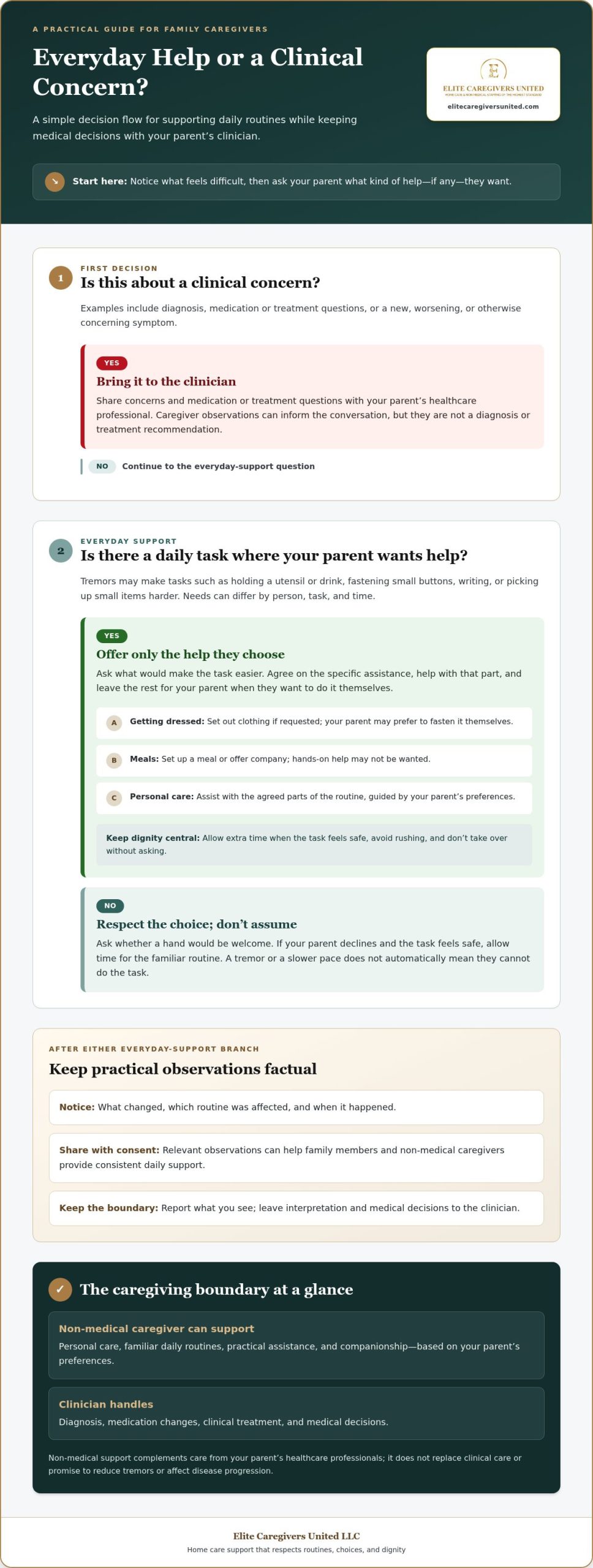
Daily living assistance supports comfort and routines. Medical management, including diagnosis and treatment decisions, belongs with a clinician. A caregiver for parent with Parkinson’s tremors can help with an agreed dressing routine, set up a meal, assist with personal care, or keep your parent company while family members take a break. Caregivers don’t diagnose Parkinson’s, change medication, or provide clinical treatment. They can’t promise to reduce tremors or affect disease progression.
How can a caregiver support daily routines without taking over?
Start with your parent’s preferences. Ask what help they want with getting dressed, eating, or personal care, and assist only with the parts they choose. Your parent may want help setting out clothing but prefer to fasten it themselves. They may welcome company during a meal without hands-on help. Respecting those choices makes care personal rather than automatic.
With your parent’s consent, share relevant observations with family members, such as a routine taking longer or a new difficulty with an everyday task. This can help family caregivers and any non-medical caregiver provide consistent daily support. It also keeps practical observations distinct from medical judgment.
When should the family involve the parent’s healthcare professional?
Bring medication questions, treatment decisions, and new, worsening, or otherwise concerning symptoms to your parent’s clinician. The National Institute on Aging provides information about Parkinson’s causes, symptoms, and treatments, but a general resource or caregiver observation can’t replace guidance based on your parent’s individual health.
It may help to keep a brief, factual record of what the family notices: what changed, which routine was affected, and when it happened. Share those observations with your parent’s care team, following their wishes and privacy preferences. Caregivers can report what they see, but shouldn’t interpret it as a diagnosis or recommend treatment changes.
For Orlando families, non-medical Parkinson’s disease home care can complement clinician-led care with practical daily assistance and companionship. Elite Caregivers United’s professional CNA team provides personal care and specialized support, while respite care gives family caregivers time to recharge. Learn about Parkinson’s disease home care in Orlando as part of a plan shaped around your parent’s routines and your family’s needs.
Practical Ways to Make Tremor-Affected Routines Safer and More Comfortable
Small adjustments can make a routine feel more manageable, but they should suit your parent rather than impose a one-size-fits-all solution. A calm, repeatable approach helps family members offer support without treating tremors as a reason to take over.
- Ask: Find out what your parent prefers and which parts of the task they want to do themselves.
- Observe: Notice what feels difficult, comfortable, or rushed without assuming you know what they need.
- Offer: Provide only the help your parent agrees to, then let them lead where they can.
- Review: Check afterward whether the arrangement felt comfortable or if they’d like to try something different next time.
This simple sequence helps a caregiver for parent with Parkinson’s tremors respond thoughtfully while keeping the parent involved in decisions about daily life.
How can families make meals and personal care less rushed?
Build enough time into the routine for your parent to move at a comfortable pace. Before a meal or personal care task, ask whether they’d like everyday items placed within easy reach or prefer to arrange them independently. During dressing, ask which steps they want to manage and where a helping hand would be welcome.
These are options to discuss, not rules for everyone. If a task remains difficult or your parent has a concern, share it with their clinician or care team rather than assuming a household adjustment will resolve it.
How can the home routine support comfort and confidence?
Familiar patterns may help a day feel more settled. If you need to change the order of a routine or provide hands-on assistance, explain what you plan to do before beginning and give your parent a chance to respond. A brief pause to ask, “Would this feel comfortable?” can make the interaction more collaborative.
Pay attention to the setting as well as the task. Your parent may prefer a particular seat, lighting arrangement, or way of organizing everyday objects. Ask what works for them and adapt together. Preferences vary, and a change that suits one person may not suit another. Household adjustments shouldn’t be presented as guaranteed ways to prevent falls or control tremors.
Revisit the routine when your parent’s preferences or needs change. The goal isn’t to make every task look effortless. It’s to support comfort, participation, and a sense of control while keeping your parent’s voice central to decisions about the help they receive.
How to Share Caregiving Responsibilities When a Parent Has Tremors
Caregiving is easier to sustain when the family plans around both the parent’s routines and the people providing support. One family member might coordinate appointments while another helps with everyday tasks. Respite care or ongoing home care can add practical assistance and give family members room to rest, work, and stay connected as a son, daughter, or spouse.
There’s no single arrangement for every household. Consider which routines need support, how much continuity your parent prefers, and what the family can realistically provide. For a broader overview of options, read this guide to non-medical home care in Orlando.
When might family caregivers benefit from additional support?
If daily responsibilities are becoming difficult to balance with work, parenting, or your own health, revisit the plan. Notice where coverage feels stretched: perhaps a family member is regularly missing work, routines are hard to maintain, or no one has time to rest. These are practical signs to discuss together, not evidence that the family has failed.
Respite assistance gives family caregivers time away while support continues for the parent. Professional help can complement family involvement, allowing loved ones to focus on meaningful time together instead of carrying every task alone. Include your parent in the conversation and respect their preferences as you consider what the family can manage.
Would scheduled, respite, or 24-hour home care fit the family’s needs?
Use this comparison to guide a family discussion, not as a fixed prescription. The right fit depends on the support needed and how the parent and family want to share care.
| Support pattern | May fit when | Family planning consideration |
|---|---|---|
| Family support | Relatives can share agreed tasks and routine check-ins. | Divide responsibilities clearly and revisit whether the plan remains manageable. |
| Scheduled home care | Help with daily living is useful at planned times. | Consider which routines benefit from consistent assistance. |
| Respite care | Family caregivers need planned relief from caregiving duties. | Decide how family members will use that time to rest or attend to other responsibilities. |
| 24-hour home care | The family is considering support across day and night. | Discuss the parent’s preferences and the household’s broader care needs. |
Needs and preferences can change, so review the arrangement as routines evolve. If continuous support is part of the discussion, explore this guide to 24-hour home care. For families seeking a caregiver for parent with Parkinson’s tremors, a thoughtful plan can preserve family involvement while sharing daily responsibilities. Explore Parkinson’s disease home care in Orlando for practical support at home.
Parkinson’s Tremor Care at Home in Orlando: A Thoughtful Next Step
For families in Orlando, additional help at home can support familiar routines while your parent continues receiving medical care from their clinician. Non-medical caregiving doesn’t treat tremors or replace clinical guidance. It provides practical assistance and companionship, with your parent’s preferences shaping how support fits into daily life.
What can Orlando families expect from non-medical home care?
Elite Caregivers United provides Parkinson’s disease home care through a professional CNA team. Non-medical support includes help with personal care and everyday routines, companionship, and respite assistance that gives family caregivers time to attend to their own needs. Families can also choose 24-hour home care when they need more continuous assistance. The right support depends on what the parent welcomes and what the family can sustain.
Caregivers assist with daily living, but don’t provide skilled nursing, physical therapy, or treatment for tremors. Medical questions and treatment decisions remain with your parent’s healthcare professional. Keeping this distinction clear helps families understand how practical home support complements clinician-led care.
How can families take the first step toward support?
Start with a family conversation. Identify which parts of the day feel challenging, such as getting ready, personal care, or maintaining a comfortable routine. Then ask your parent what help they would welcome, what they prefer to do independently, and how they’d like family members and caregivers to communicate. These details help everyone approach support with respect and shared expectations.
As a caregiver for parent with Parkinson’s tremors, you can remain closely involved without carrying every responsibility alone. Respite, personal care, and ongoing home care are different ways to share support. Begin with the routines that matter most, then discuss care goals and preferences together. A thoughtful plan can make room for practical assistance and meaningful family time.
For support in Orlando, explore Parkinson’s home care and caregiver support from Elite Caregivers United. Talking through your parent’s preferences and your family’s needs is a calm first step toward a more supported routine at home.
Build a Supportive Plan That Grows With Your Family
Supporting a parent through Parkinson’s tremors starts with noticing what feels challenging, asking what help they welcome, and making room for their preferences in everyday routines. A caregiver for parent with Parkinson’s tremors can offer practical, respectful assistance without taking away independence, while medical questions and treatment decisions remain with the parent’s clinician.
Caregiving doesn’t have to rest on one family member. Sharing responsibilities, arranging respite, or bringing in ongoing home care can help create a more sustainable balance while keeping family relationships at the center. For Orlando families, Elite Caregivers United provides Parkinson’s disease home care through a professional CNA team, along with personal care, respite, and 24-hour home care. This non-medical support complements, but doesn’t replace, clinician-led care.
If additional help could make daily life more manageable, explore Parkinson’s home care in Orlando from Elite Caregivers United. Discussing your parent’s wishes and your family’s needs can be a practical first step toward a more supported routine.
Frequently Asked Questions
Can a caregiver help my parent with Parkinson’s tremors?
Yes. A non-medical caregiver can support daily living while respecting your parent’s preferences and independence. Help may include personal care, companionship, and assistance with familiar routines, with your parent deciding what they’d like help with. Caregivers don’t diagnose Parkinson’s or manage treatment. They can share observations with the family, while questions about symptoms or medical care go to your parent’s clinician.
What can a caregiver do when Parkinson’s tremors make daily tasks difficult?
A caregiver can offer agreed assistance with tasks such as dressing, meal routines, writing, or handling everyday belongings. They can allow extra time, ask which steps your parent wants to do independently, and help only with the parts your parent welcomes. A caregiver for parent with Parkinson’s tremors can also provide companionship and tell family members about relevant changes in routines, without claiming to treat tremors.
Can a caregiver stop or treat Parkinson’s tremors?
No. A non-medical caregiver doesn’t diagnose Parkinson’s, provide clinical treatment, or change medication, and caregiving can’t be promised to stop or reduce tremors. Caregivers can help with daily routines and report observations to the family while respecting your parent’s preferences. Direct medication questions, treatment decisions, or new and concerning symptoms to the clinician overseeing your parent’s care.
How can I help my parent eat when they have Parkinson’s tremors?
Ask your parent what would make mealtime feel more comfortable, then allow time for them to eat at their own pace. They may appreciate help arranging the meal or placing familiar items within comfortable reach, while preferring to manage other parts themselves. Avoid rushing or taking over without consent. If eating becomes persistently difficult or raises health concerns, discuss it with your parent’s clinician.
When should I seek additional help caring for a parent with Parkinson’s?
Consider more support if daily routines are becoming hard to sustain alongside work and other responsibilities, family members have little time to rest, or your parent would welcome help with personal care or companionship. Identify which parts of the day feel most demanding and what assistance your parent prefers. Respite or ongoing home care can complement family involvement rather than replace meaningful time together.
Is non-medical home care available for Parkinson’s in Orlando?
Yes. Elite Caregivers United provides Orlando families with Parkinson’s disease home care and personal care through a professional CNA team. Non-medical support can include assistance with daily living and companionship, while medical assessment and treatment remain with your parent’s clinician. Families can consider respite or 24-hour home care based on their needs and preferences, with support centered on the parent’s routines.
Can a family caregiver arrange respite care for a parent with Parkinson’s?
Yes. Respite care supports your parent while a family caregiver takes time to rest or manage other responsibilities. It’s a practical way to share caregiving, not a failure to care. Discuss your parent’s preferences and the routines where help would be welcome, then plan how respite fits with family involvement. Elite Caregivers United provides respite care for Orlando families.