
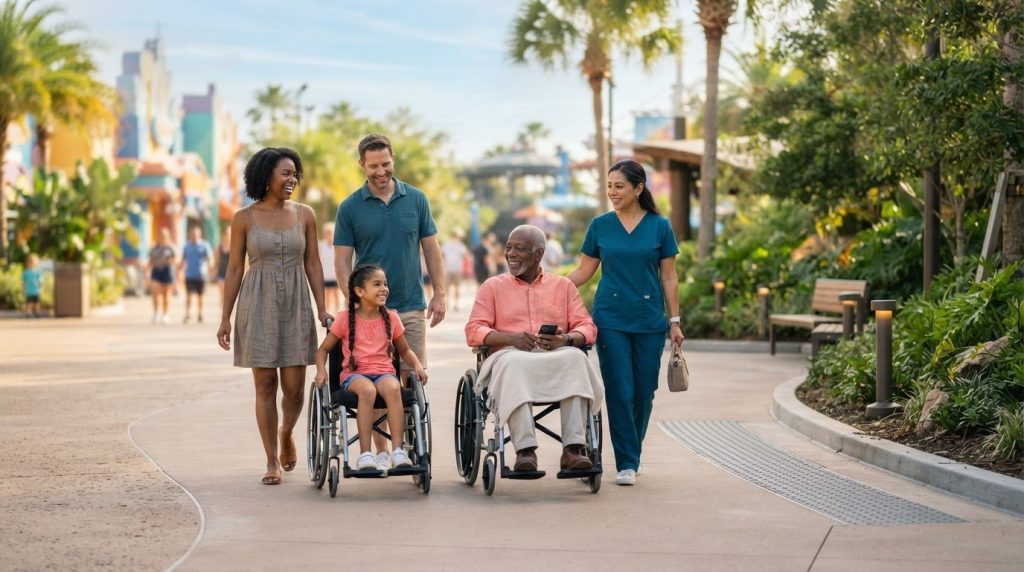
Securing an official accessibility pass opens park queues, but it cannot push a wheelchair across ten miles of concrete or calm sensory overload in a packed soundstage corridor. If you are researching the special needs assistance Universal Studios offers, you already carry the emotional weight of planning every detail, from complex pre-registration steps to the quiet guilt felt when neurotypical siblings wait on the sidelines. You deserve a family vacation that feels truly restorative, rather than an exhausting continuation of daily caregiving routines.
In this 2026 guide, you will discover how Universal Orlando accessibility accommodations work, from IBCCES pre-arrival registration to managing digital return times directly in the park app. We’ll outline practical ways to balance low-sensory rest zones with major attractions, while showing how dedicated Orlando park caregivers can provide steady, hands-on support so every member of your family can fully relax and share in the joy.
Key Takeaways
- Understand how the ecosystem of special needs assistance Universal Studios offers bridges digital line accommodations, sensory zoning, and physical accessibility.
- Complete your IBCCES pre-registration online at least 48 hours prior to arrival to seamlessly link and manage your digital Attraction Assistance Pass on your phone.
- Recognize the vital differences between institutional pass accommodations and hands-on physical support, especially when navigating miles of crowded walkways and managing companion restroom transfers.
- Identify dedicated quiet rooms and low-traffic decompression sanctuaries across the parks to preempt sensory overload and keep everyone calm.
- Learn how dedicated Orlando amusement park caregivers provide steady one-on-one companion care, freeing parents to share high-thrill rides with neurotypical siblings without worry.
Universal Studios Special Needs Assistance: Core Accessibility Accommodations
Planning a theme park vacation requires careful preparation, especially when balancing medical routines, sensory limits, and physical endurance. Official special needs assistance Universal Studios provides operates as an integrated ecosystem of cognitive, sensory, and physical accommodations. Rooted in Title III mandates established under the Americans with Disabilities Act (ADA), these resort services aim to provide equitable access to rides, dining, and live entertainment. However, they are designed to establish equal opportunities to experience the parks rather than offer immediate, line-skipping privileges. These unified guidelines apply across Universal Studios Florida, Universal’s Islands of Adventure, and Volcano Bay water theme park.
Scope of Park Accommodations for Cognitive and Physical Needs
Universal designs accommodations around specific functional barriers rather than generic diagnoses. For neurodivergent visitors and those with autism spectrum disorder, the park provides modified queue waiting protocols to minimize exposure to loud, enclosed soundstages. For physical access, standard queues accommodate manual wheelchairs and electric convenience vehicles (ECVs). Families managing sensory processing sensitivities can also request a “Stroller as Wheelchair” marker at Guest Services, allowing an everyday stroller to function as a familiar, soothing environment inside ride queues.
Rider Safety Requirements and Attraction Transfer Protocols
Every attraction maintains precise physical safety constraints governed by manufacturer dynamics. The resort publishes the comprehensive Universal Orlando Rider’s Guide, which outlines vital safety ratings, sensory triggers, and physical transfer expectations. Reviewing these requirements in advance helps prevent difficult moments at the loading platform:
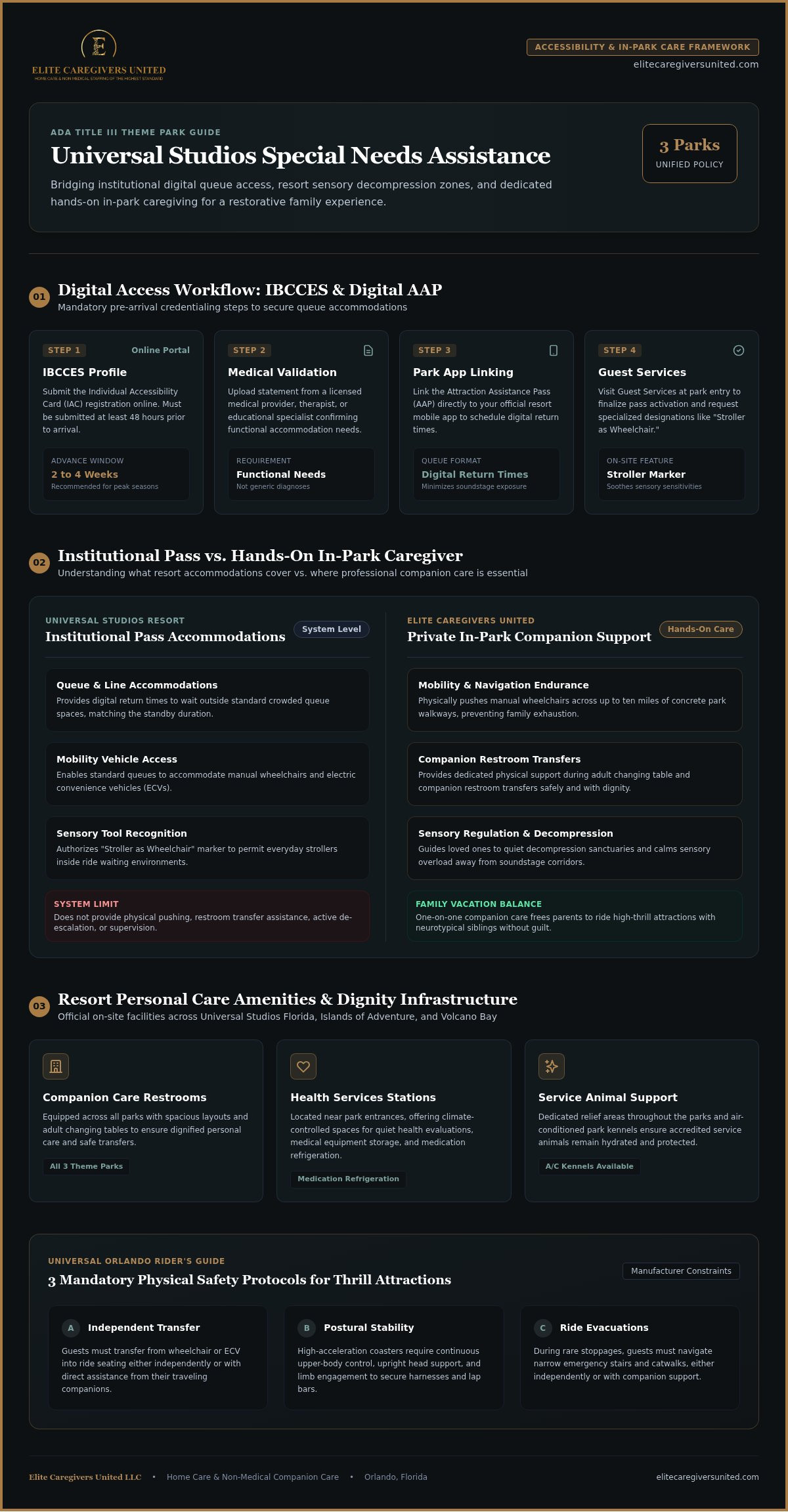
- Independent Transfer: Many thrill attractions require riders to transfer from a wheelchair or ECV into standard ride seating, either independently or with exact physical support from their travel party.
- Postural Stability: High-acceleration coasters require continuous upper-body control, upright head support, and sufficient natural or prosthetic limb engagement to secure complex lap bars and over-the-shoulder harnesses.
- Ride Evacuations: Safety protocols mandate that guests be able to navigate narrow walkways or emergency stairs during rare ride stoppages, either independently or assisted by their companions.
Resort Amenities Supporting Personal Dignity and Care
Maintaining basic personal care routines in a bustling park should never compromise dignity. Universal equips its destination with dedicated companion care restrooms across all parks, featuring ample space and adult changing tables to facilitate safe transfers. Additionally, Health Services stations near park entrances offer climate-controlled spaces for quiet health checks, specialized medical equipment storage, and temperature-sensitive medication refrigeration. Clearly marked service animal relief areas and air-conditioned park kennels ensure that accredited service animals remain comfortable, hydrated, and protected throughout your visit.
Navigating the Universal Orlando Accessibility Program: IBCCES and AAP
Accessing specialized queue support requires deliberate planning long before you step onto CityWalk. Universal Orlando partners with an independent credentialing board to ensure requests remain standardized, confidential, and medically validated. For families seeking reliable special needs assistance Universal Studios provides, understanding this digital verification pathway eliminates arrival friction and protects precious vacation time.
Securing the IBCCES Individual Accessibility Card (IAC)
To qualify for cognitive or non-mobility queue accommodations, you must first complete an IBCCES Individual Accessibility Card application online. This profile must be submitted at least 48 hours prior to your park visit, though submitting two to four weeks in advance is highly recommended during peak holiday windows. You will need to upload documentation from a licensed medical provider, therapist, or educational specialist detailing the specific accommodations your loved one requires. Once approved, the credential remains valid for a full 365 days across all participating partner venues.
Activating Your Attractions Assistance Pass (AAP) at Guest Services
After IBCCES verifies your documentation, Universal contacts you to discuss your specific needs. Upon arriving at the front gate of Universal Studios Florida, Islands of Adventure, or Epic Universe, visit Guest Relations to finalize activation. Team members won’t ask invasive questions about diagnoses. Instead, they focus on functional barriers by asking questions like: “What specific challenges occur when waiting in an enclosed, crowded line?” The approved accommodation is then linked digitally to your official Universal Orlando mobile app, covering the pass holder and up to five travel companions.
How Return Times and Queue Management Function in the Parks
The Attraction Assistance Pass is not an immediate express line skip; it provides a manageable virtual wait. Understanding its daily mechanics ensures smooth pacing across the resort:
- Wait Thresholds: If a ride’s posted wait is under 30 minutes, your party is usually directed straight to the alternate access entrance. If the standby wait is 30 minutes or greater, a team member scans your app to assign a digital return time equivalent to the wait.
- Single Reservation Rule: You may hold only one active return time simultaneously. New return reservations become available roughly five to ten minutes after checking into your scheduled attraction.
- Rider Switch Compatibility: Families can combine the AAP with Universal’s Rider Switch protocol, enabling one caregiver to wait comfortably with a child while others ride, then swapping places without waiting in line twice.
Spending return windows in calm dining patios or shaded gardens prevents exhaustion. When coordinating these app schedules alongside regular hydration, toileting transfers, and sibling routines starts feeling overwhelming, partnering with dedicated theme park companions can restore breathing room and calm confidence to your entire family outing.
Park Accessibility Passes vs. Private In-Park Caregivers: Comparing Support Levels
Universal’s digital Attraction Assistance Pass provides valuable queue relief, yet it solves only half of the vacation equation. While official special needs assistance Universal Studios offers ensures equitable physical entry, it cannot lift a grown child into a ride seat, monitor subtle sensory changes, or push a wheelchair across sprawling parks. Guests routinely walk over ten miles per day exploring Universal Studios Florida and Islands of Adventure. For family members handling manual propulsion and transfers under the intense Florida sun, physical exhaustion sets in rapidly, shifting a cherished trip into demanding physical labor.
What Universal Park Accommodations Do-and Do Not-Provide
Park infrastructure aligns with the U.S. Access Board amusement ride accessibility guidelines, ensuring wide ramps, companion restrooms, and transfer points. However, park team members cannot provide hands-on personal assistance. They cannot assist with feeding, repositioning, restroom transfers, or personal hygiene. Nor can they step in during sensory overstimulation outside the ride queue. The AAP manages waiting logistics, but it offers no support when a loved one feels overwhelmed on a crowded concourse.
The Measurable Value of Professional Hands-On Park Care
Bringing a professional theme park caregiver creates a protective bridge between park amenities and your loved one’s comfort. Having an extra set of skilled hands to push mobility devices preserves your own physical vitality for shared family moments. Trained in behavioral observation, an experienced companion recognizes early physiological signs of sensory distress, intervening with calming routines before a full meltdown occurs. Most importantly, professional respite eliminates the painful guilt felt when neurotypical siblings miss out on high-thrill rides because a parent must wait behind.
Direct Comparison: Independent Touring vs. Supported Park Days
Comparing these two approaches reveals how dedicated care transforms the vacation experience for everyone involved:
- Physical Stamina: Independent families carry the full weight of navigating miles of pavement, managing transfers, and tracking gear alone. Supported families share the physical effort, avoiding the joint strain and exhaustion of full-day mobility management.
- Emotional Presence: Without support, parents often feel split between caregiving duties and engaging other children. With a companion present, parents can ride roller coasters with neurotypical siblings while knowing their special needs child is resting safely nearby.
- Pacing and Completion: Independent groups frequently cut park days short when sensory overload strikes. Supported groups maintain steady pacing by balancing attraction return windows with proactive decompression in quiet areas.
Engaging a skilled Orlando amusement park nanny allows you to step away from constant vigilance and return to simply being a parent, confident that compassionate, professional help is always by your side.
Practical Touring Strategies: Sensory Decompression and Mobility Navigation
A successful park day relies on proactive pacing rather than reactive problem-solving. While official special needs assistance Universal Studios offers simplifies queue access, navigating high-density environments requires a deliberate touring strategy. Sensory inputs accumulate quickly in theme parks, making structured decompression intervals essential to prevent sensory overload and physical exhaustion.
Navigating Sensory-Heavy Zones in Universal Parks
Immersive lands like The Wizarding World of Harry Potter feature dense crowd corridors, echoing stone walkways, and sudden pyrotechnics. In Diagon Alley, the fire-breathing dragon atop Gringotts generates loud concussive roars and sudden heat bursts that frequently startle sensory-sensitive visitors. To minimize distress, schedule high-intensity screen simulators like Transformers or The Amazing Adventures of Spider-Man with buffer periods between them. Equipping your travel bag with noise-canceling headphones, cooling towels, and weighted lap pads provides instant physical reassurance when crowd densities peak.
Designated Quiet Sanctuaries and Low-Stimulation Retreats
When sensory fatigue surfaces, knowing where to find quiet shelter allows your loved one to reset in comfort. Universal provides specialized facilities alongside natural outdoor retreats:
- Universal Studios Florida Quiet Room: Located inside Family Health Services near the front entrance turnstiles, this dedicated space offers dimmable lighting, soft flooring, and sensory wall panels. Use is recommended up to 30 minutes per family to maintain availability.
- Islands of Adventure First Aid: Situated near the front turnstiles, offering air-conditioned recovery rooms for acute sensory decompression.
- Open-Air Green Sanctuaries: Central Park in Universal Studios Florida offers quiet, shaded pathways along the lagoon. In Islands of Adventure, the lower waterfront boardwalks behind Mythos and the shaded bypass trails through Jurassic Park provide natural crowd buffers.
Mobility Equipment Management and Climate Preparedness
Managing mobility equipment under the Florida sun demands practical foresight. Universal rents standard manual wheelchairs for $15.00 daily and Electric Convenience Vehicles (ECVs) for $75.00 per day plus tax, along with a $50.00 refundable deposit. Remember that park-rented devices cannot leave the security perimeter to travel to CityWalk or resort hotels. For water rides like Jurassic Park River Adventure or Popeye & Bluto’s Bilge-Rat Barges, prepare for wet seat transfers by bringing plastic wheelchair covers to keep personal seating cushions dry.
Beat the mid-afternoon heat by establishing scheduled hydration breaks every sixty minutes. If pushing a wheelchair across sprawling walkways while monitoring sensory cues feels exhausting, hire an Orlando amusement park caregiver to support your family with dedicated mobility escort and mindful decompression care.
Professional Park Companionship: Elite Caregivers United in Orlando
While digital accommodations address line waiting, true peace of mind comes from having dedicated, compassionate support by your side. Elite Caregivers United LLC stands as Orlando’s premier provider of specialized theme park caregivers and nannies. Located on South Kirkman Road right beside Universal Orlando, our team bridges the gap between institutional special needs assistance Universal Studios provides and your family’s personal well-being.
Tailored Theme Park Assistance by a Dedicated CNA Team
Led by certified nursing assistants, our staff delivers compassionate, non-medical care tailored to individuals with autism spectrum disorder, Down syndrome, dementia, and physical mobility challenges. Park companions handle the physical demand of manual wheelchair navigation, easing the strain of rolling paths and crowded concourses. They provide discreet assistance during companion restroom transfers, deliver timely hydration prompts, and implement gentle sensory grounding before overstimulation peaks. This specialized park support integrates seamlessly with our broader non-medical home care in Orlando, providing comforting continuity throughout your entire vacation stay.
Respite for Parents and Vacation Balance for Siblings
A balanced vacation means every family member gets to experience the magic without sacrifice or guilt. With a trained park caregiver attending one-on-one to your child’s pacing and sensory needs, parents can freely join neurotypical siblings on high-thrill coasters like the Jurassic World VelociCoaster. Our flexible care arrangements adapt entirely to your itinerary:
- In-Park Accompaniment: Flexible hourly or full-day assistance navigating queues, dining, and decompression zones alongside your family.
- Midday Hotel Escort: Supporting an overstimulated child or aging grandparent back to your resort for a restful nap while other family members remain in the park.
- Evening Hotel Respite: Professional in-room supervision allowing parents to enjoy a quiet, restorative dinner at CityWalk.
Seamless Booking and Personalized Vacation Care Planning
Every family’s journey begins with a thorough intake assessment designed to understand your loved one’s specific sensory triggers, physical transfer requirements, and favorite comfort routines. We coordinate directly around your travel schedule, meeting your party at your on-site resort lobby or directly at Universal’s park entrance. You don’t have to carry the physical and emotional weight of caregiving alone under the Florida sun. Connect with Elite Caregivers United LLC today to reserve a dedicated theme park companion and restore restful balance to your Orlando getaway.
Transform Your Universal Orlando Vacation Into a Restful Family Journey
Securing institutional special needs assistance Universal Studios provides is an essential first step toward accessible attractions, yet true vacation freedom happens when daily caregiving demands are shared. By pairing advance IBCCES digital verification with mindful sensory pacing, you establish a reliable structure that protects your loved one’s comfort throughout the resort.
Located on Kirkman Road just minutes from Universal Orlando Resort, Elite Caregivers United LLC provides the hands-on partnership that makes a genuine family vacation possible. Our experienced, CNA-led team delivers compassionate non-medical mobility support, discreet restroom assistance, and personalized sensory decompression tailored to your loved one’s specific needs. Whether you require flexible hourly park accompaniment, full-day mobility navigation, or evening hotel respite care, our dedicated caregivers ensure that everyone enjoys their time in Orlando. Connect with our compassionate Orlando theme park caregivers today to step back from the physical strain of caregiving and create joyful, lasting memories together.
Frequently Asked Questions
How does the Universal Studios Attractions Assistance Pass work for guests with special needs?
The Universal Attractions Assistance Pass functions as a digital virtual queue managed inside the official park app. When an attraction’s posted standby wait is under 30 minutes, eligible guests are directed into an alternate access line immediately. For wait times of 30 minutes or greater, a digital return time is assigned matching the standby duration. As a cornerstone of special needs assistance Universal Studios provides, it allows cardholders and up to five guests to wait outside crowded corridors.
Can I apply for the Universal Orlando disability pass on the day of my visit?
No, you cannot complete the required medical credentialing at the park entrance on the day of your visit. Universal requires guests requesting queue accommodations to apply online for an IBCCES Individual Accessibility Card at least 48 hours before arriving. Park guest service team members can’t evaluate medical letters or issue new accommodation passes at ticket windows without prior third-party verification, making advance digital registration essential for your travel party.
What medical documentation is required to qualify for an IBCCES Individual Accessibility Card?
You must upload written documentation from a licensed physician, clinical specialist, psychologist, or educational authority such as an individualized education plan (IEP). The documentation must be dated within the past year and clearly describe why the individual cannot tolerate standing in a standard line environment. It doesn’t need to disclose a detailed medical diagnosis, focusing instead on the functional limitations and individual physical or cognitive accommodations required during a visit.
How does hiring a private theme park caregiver help my family during a Universal vacation?
While park passes manage digital return times, private theme park caregivers handle the physical and emotional demands of the day. A dedicated companion takes over manual wheelchair propulsion across miles of pavement, monitors subtle behavioral signals to prevent sensory meltdowns, and assists with personal care routines. This hands-on presence allows parents to share thrill rides with neurotypical siblings, knowing their loved one is safe, calm, and fully supported.
Are Universal Orlando rides accessible for non-ambulatory guests in manual or motorized wheelchairs?
Most ride queues are fully accessible for wheelchairs and motorized scooters, but attraction vehicles themselves generally require transferring into standard ride seating. Select gentle attractions feature specialized vehicles accommodating non-folding manual wheelchairs directly. For high-speed coasters, guests must maintain upright posture and transfer independently or with the physical assistance of their travel companions, as ride operators aren’t permitted to physically lift or transfer guests into ride units.
Where can guests with autism or sensory processing needs decompress inside Universal Studios?
Guests can utilize the dedicated quiet room located inside Family Health Services near the front entrance of Universal Studios Florida, which features soft flooring, sensory wall panels, and dimmable lighting. Islands of Adventure provides private resting rooms within its Health Services station. For open-air decompression, shaded waterfront areas in Central Park or the lower lagoon pathways behind Mythos offer peaceful spaces away from heavy foot traffic.
Can an Elite Caregivers United companion assist with restroom transfers and mealtime support in the park?
Yes, our certified nursing assistant (CNA) team provides dedicated non-medical personal care support throughout your park visit. Our caregivers assist with companion restroom transfers, discreet hygiene routines, nutritional mealtime support, and regular hydration prompts. While we don’t provide skilled clinical nursing or physical therapy, our park companions deliver attentive hands-on assistance, giving families relying on special needs assistance Universal Studios destinations offer complete confidence and dignified comfort.