

Imagine the quiet stillness of a late Orlando afternoon, where the only sound is the ticking of a clock and the heavy weight of your own exhaustion. You’ve spent the day managing medication, redirecting repetitive questions, and gently guiding your spouse away from the front door, yet the thought of taking even a two-hour nap feels like a betrayal of your devotion. You aren’t alone in this delicate balance of love and depletion, as many families find that the emotional toll of constant vigilance eventually outweighs their physical strength. Seeking professional respite care for dementia patients at home Orlando isn’t an admission of defeat; it’s a vital strategy to ensure that both you and your loved one can continue this journey with dignity.
This 2026 guide explores how to secure CNA-led relief that honors your family’s established routines while providing the specialized support necessary to manage complex behaviors like sundowning or wandering. You’ll discover how a structured approach to home care can offer you the personal time you’ve been missing without triggering the anxiety that often accompanies a change in environment. We’ll walk through the essential steps for finding a compassionate partner who understands that your peace of mind is just as important as your loved one’s safety, ensuring a smooth transition that preserves the comfort of home while providing you with the space to breathe.
Key Takeaways
- Understand the vital distinction between general assistance and specialized memory support that focuses on maintaining a familiar environment and preserving the senior’s dignity.
- Explore how a professional CNA team provides a higher tier of care, skillfully managing complex dementia behaviors such as sundowning and wandering with calm authority.
- Learn how to implement the “Slow Introduction” method to build trust and ensure that respite care for dementia patients at home Orlando becomes a welcome part of your loved one’s routine.
- Discover the flexibility of modern home care options in Central Florida, ranging from brief periods of rest to comprehensive 24/7 support tailored to your family’s needs.
- Gain practical strategies for overcoming caregiver guilt by reframing professional relief as an essential component of holistic well-being for both you and your loved one.
What is In-Home Dementia Respite Care in Orlando?
At its heart, respite care for dementia patients at home Orlando is a specialized support system designed to provide primary caregivers with a vital window of rest while ensuring their loved one remains in a secure, familiar environment. Unlike general respite services that might offer basic supervision or light housekeeping, dementia-specific support is rooted in an understanding of cognitive decline. It involves a strategic approach to care that prioritizes routine preservation and emotional stability, acknowledging that for a person with memory loss, even small changes in their surroundings can lead to significant distress. This service isn’t merely a temporary substitution of presence; it’s a professional intervention that maintains the delicate “familiarity loop” that keeps a senior grounded in their reality.
Choosing to keep a loved one at home for respite care rather than utilizing a facility-based program often yields better clinical and emotional outcomes. In a residential setting, the sudden shift in sights, sounds, and staff can trigger “transfer trauma,” a state of heightened confusion and anxiety that may take weeks to resolve. By introducing a professional CNA into the home, the senior stays surrounded by the sensory cues they know, such as the scent of their own kitchen or the specific view from their favorite chair. This continuity of environment is a powerful tool in managing the behavioral symptoms of Alzheimer’s and Parkinson’s, providing a sense of quiet confidence that a clinical facility simply cannot replicate.
The Core Benefits of Home-Based Support
One of the most profound advantages of home-based respite is the level of one-on-one attention provided by a dedicated caregiver. In many Orlando facilities, staff members must balance the needs of multiple residents simultaneously, which can lead to missed cues or delayed responses to wandering and agitation. A CNA-led home care team focuses entirely on your loved one, offering personalized engagement that honors their unique history and preferences. This individualized approach allows for a customized schedule that aligns perfectly with your family’s lifestyle, whether you require support for a few hours of personal time or 24/7 assistance during a busy week.
Who Needs Dementia Respite Care?
The most common candidate for respite care is often the “silent patient,” the family caregiver who has reached the limits of their physical and emotional endurance. It’s easy to overlook your own needs when you’re focused on the safety of another, but chronic stress can lead to serious health complications and caregiver burnout. If you find yourself experiencing frequent irritability, sleep deprivation, or a sense of isolation, it’s a clear signal that your loved one’s care requirements have surpassed your individual capacity. Utilizing respite as a proactive tool, rather than waiting for an emergency or a total collapse of your own well-being, ensures that you can continue to provide the high-quality care your loved one deserves for years to come.
Why CNA-Led Memory Care Surpasses Standard Companion Services
While many families initially seek a companion to sit with their loved one, the complexities of neurodegenerative conditions often require a more sophisticated level of oversight. A Certified Nursing Assistant (CNA) brings a clinical perspective to the home that standard companion services cannot offer. They’re trained to observe the subtle shifts in physical and emotional health that a layperson might miss, ensuring that the care provided is as much about health preservation as it is about companionship. This professional gaze transforms a simple visit into a proactive health monitoring session, providing families with a sense of quiet confidence that their loved one is truly seen.
Managing the “witching hour” or sundowning requires more than just patience; it requires a deep understanding of sensory triggers and environmental stressors. When you arrange for respite care for dementia patients at home Orlando, a CNA-led team utilizes evidence-based strategies to soothe agitation before it escalates into a crisis. By monitoring for physical discomfort or environmental overstimulation, these professionals maintain a calm atmosphere, allowing the senior to transition into the evening hours with peace rather than fear. They don’t just react to behaviors; they anticipate them, creating a steady and deliberate rhythm that mimics the family’s own care style.
Personal care tasks, such as bathing and dressing, are often the most stressful moments for both the senior and the family. A professional caregiver approaches these intimate duties with a focus on preserving the individual’s dignity, using gentle techniques that empower the senior rather than overwhelming them. This professional distance, combined with heartfelt empathy, often reduces the resistance and shame a senior might feel when being assisted by a child or spouse. It’s a delicate balance of formal respect and genuine human kindness that keeps the senior’s vitality at the forefront of every interaction.
Advanced Behavioral Management Techniques
Redirection is an art form that requires a “wise protector” approach. Instead of correcting a senior who is confused about their location, a skilled CNA enters their reality, using validating language to lower anxiety. They create a failure-free environment by simplifying tasks and removing obstacles that might lead to frustration, ensuring your loved one feels successful and safe throughout the day. These strategies focus on de-escalation without confrontation, maintaining a supportive environment that fosters emotional well-being even during the primary caregiver’s absence.
Safety and Vitality Monitoring
Beyond behavioral support, the clinical training of a CNA is indispensable for identifying early indicators of illness, such as dehydration or respiratory changes, which often manifest as increased confusion in dementia patients. They implement rigorous safety protocols tailored to the unique layout of Florida homes, focusing on fall prevention and kitchen security. For families seeking this higher tier of clinical dedication, exploring the specialized CNA-led team at Elite Caregivers United provides a pathway to professional reliability and heartfelt support.
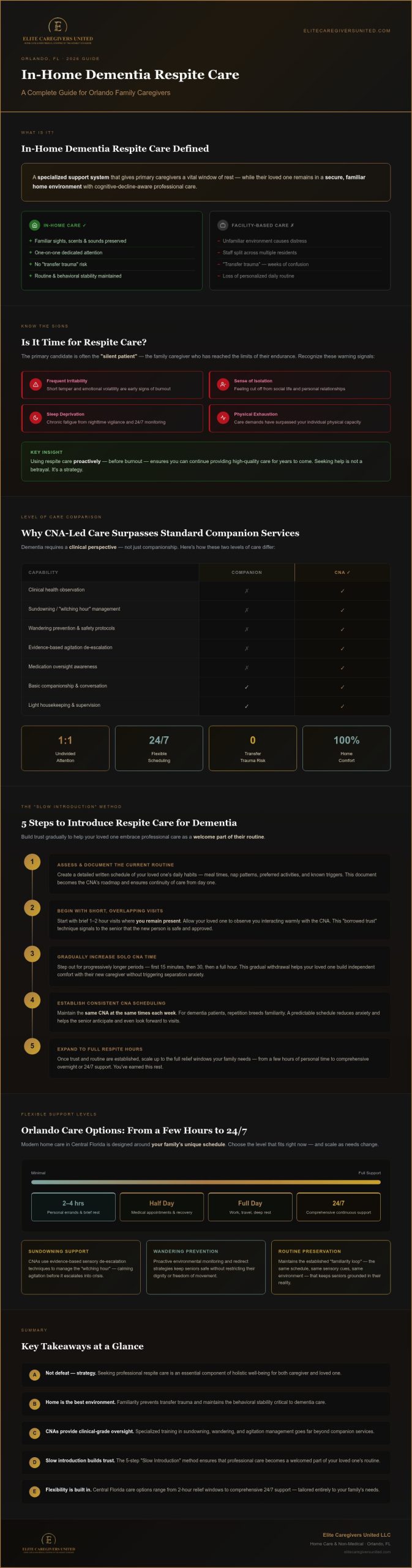
5 Steps to Introduce Respite Care for Dementia
Introducing a new face into the sacred space of your home requires a steady, rhythmic approach to prevent the anxiety that often accompanies change. For families securing respite care for dementia patients at home Orlando, the transition is most successful when it’s treated as a gentle unfolding rather than a sudden event. By following a structured onboarding process, you can bridge the gap between your own intuitive care and the professional support of a CNA. This methodical introduction ensures that your loved one feels safe while you gain the confidence to step away for your own well-being.
- Implement the “Slow Introduction”: Begin with short, one-hour visits where you remain present, allowing your loved one to acclimate to the new caregiver’s voice and presence without feeling abandoned.
- Utilize “The Friend” Narrative: Frame the caregiver’s arrival as a visit from a helpful friend or a “household assistant” to bypass the resistance many seniors feel toward the idea of needing “care.”
- Codify the Unwritten Rules: Document the specific nuances of your loved one’s day, such as how they prefer their coffee or the exact way they like their pillows arranged, to maintain a seamless continuity of routine.
- Establish First-Session Goals: Focus the initial visit on simple engagement and safety rather than complex tasks, allowing the relationship to form naturally through shared activities.
- Conduct a 48-Hour Review: Evaluate the transition after the second visit by observing your loved one’s mood, appetite, and sleep patterns to ensure the partnership is flourishing.
The Initial Consultation: What to Share
A successful partnership begins with a deep dive into the senior’s personal history and local preferences. It’s helpful to share details about their “Orlando routine,” such as a fondness for morning walks around Lake Eola or a specific time they enjoy sitting on the lanai to watch the birds. Providing a list of favorite musical artists or topics that spark joy, like stories from their career or family history, allows the CNA to move beyond clinical tasks and offer genuine, heartfelt companionship that resonates with the individual’s soul. These details transform a service into a personalized experience that preserves the senior’s dignity.
Managing the “Hand-off” Without Guilt
The moment of departure is often the most emotionally charged for the family caregiver, yet a calm and confident exit is essential for the patient’s stability. It’s best to use a brief, positive goodbye ritual rather than a drawn-out explanation that might trigger distress. Once you’ve entrusted your loved one to the CNA-led team, it’s vital that you actually leave the premises. This physical distance allows you to truly recharge while giving the professional caregiver the space to establish their own rapport and manage any initial adjustment periods with quiet authority. Trusting the process is the first step toward your own restoration.
Logistics and Planning for Respite Care in Orlando
Planning for respite care for dementia patients at home Orlando involves more than just checking a calendar; it’s about aligning professional support with the specific rhythm of your household. Families often start with hourly visits to manage weekly errands, yet they quickly realize that longer blocks of time provide the deep, restorative rest necessary to prevent burnout. In 2026, the Orlando home care landscape has evolved to offer highly flexible models, allowing you to scale support from a few hours of afternoon relief to comprehensive 24/7 oversight as your loved one’s needs shift. This scalability ensures that your support system grows alongside the complexities of the condition, providing a steady foundation of reliability.
Local geography plays a surprisingly significant role in coordinating this support. Acknowledging the unique traffic patterns of the I-4 corridor or the sprawling nature of communities from Lake Nona to Winter Park, a local agency ensures that caregivers are strategically positioned to maintain punctuality. This geographical mindfulness prevents disruptions to your loved one’s schedule, ensuring that the “familiarity loop” remains unbroken. Using these sessions as a proactive trial run also helps families prepare for future long-term care needs, allowing the senior to build a bond with a CNA-led team before 24-hour assistance becomes a permanent necessity.
24-Hour In-Home Respite vs. Short-Term Facility Stays
While some families consider facility-based “respite beds,” 24-hour in-home care offers a level of continuity that clinical environments cannot match. Staying at home eliminates the disorientation of a new floor plan and unfamiliar roommates, which are common triggers for agitation in memory care patients. When you choose home-based support, your loved one receives undivided attention in the setting where they feel most powerful and secure. For a deeper look at how this continuous oversight functions, you can explore The Essential Guide to 24-Hour Home Care in Orlando to understand the safety and comfort benefits of around-the-clock professional presence.
Funding and Resources for Orlando Families
Navigating the financial aspect of care is a priority for every family, and Central Florida offers several resources to help manage these costs. Many long-term care insurance policies in 2026 specifically include provisions for in-home respite, recognizing its value in delaying more expensive institutionalization. Local support groups and senior resource centers in Orlando can provide additional guidance on community-based grants or programs designed to support family caregivers. Non-medical agencies play a crucial role here, offering high-tier CNA support that fits within a family’s budget by providing targeted, efficient care. If you’re ready to discuss a plan that honors your budget and your loved one’s dignity, contact our local team for a personalized care consultation.
Elite Caregivers United: Professional CNA Support for Your Family
Choosing a partner to enter your home during your most vulnerable moments requires a foundation of absolute trust and clinical excellence. At Elite Caregivers United, we believe that providing respite care for dementia patients at home Orlando is a sacred responsibility, one that demands more than just a watchful eye. Our team is composed exclusively of Certified Nursing Assistants (CNAs), ensuring that every interaction is grounded in professional expertise and a deep understanding of neurodegenerative health. This commitment to a higher tier of care allows us to act as a seamless extension of your family, preserving your loved one’s dignity while offering you the profound relief you’ve been seeking.
The “Elite” difference lies in our proactive and attentive personality, positioning our agency as a steady, guiding presence for Central Florida families. We don’t believe in one-size-fits-all solutions; instead, we craft individualized care plans that prioritize the sensory cues and established rhythms your loved one relies upon. Whether you need a few hours of afternoon rest or comprehensive 24/7 oversight, our CNAs integrate with your existing family routine to ensure that professional support feels like a natural progression rather than a disruption. By focusing on the nuances of your loved one’s personality and history, we provide a sense of vitality and emotional security that honors the person behind the diagnosis.
A Compassionate Partner in Memory Care
Our local roots in the Orlando community run deep, allowing us to offer a level of personalized service that larger, national franchises often struggle to replicate. We’ve seen firsthand how the right support can transform a household, moving a family from a state of chronic stress to one of quiet confidence and peace. Families across Central Florida have shared how our respite services allowed them to rediscover their own well-being while knowing their spouse or parent was safe in the hands of a “wise protector.” For more insights on our philosophy of care, read our detailed guide on Compassionate Respite Care for Dementia Patients in Orlando.
Getting Started with Your Respite Plan
Beginning your journey with professional respite care is a deliberate and supportive process designed to alleviate your anxiety. It starts with a comprehensive in-home assessment where we listen to your story, identify potential triggers, and document the specific preferences that make your loved one unique. We then match you with a CNA whose skills and personality align with your family’s needs, facilitating a smooth introduction that prioritizes the senior’s comfort. If you’re ready to secure the professional relief you deserve, schedule your professional consultation with Elite Caregivers United today and take the first step toward a more balanced, nurturing home environment.
Embracing a Sustainable Path for Your Caregiving Journey
Your dedication to your loved one is a profound expression of love, yet sustaining that level of constant vigilance requires the presence of a supportive and highly skilled partner. By choosing specialized respite care for dementia patients at home Orlando, you ensure that your family member remains anchored in the comfort of their own routine while receiving the expert oversight of a professional CNA. This clinical approach doesn’t just manage symptoms like sundowning or wandering; it actively preserves the senior’s dignity and vitality in the environment they know best.
As a Licensed Florida Home Health Agency, our CNA-led professional care team provides 24/7 local Orlando support tailored to the unique needs of memory care families. We’re here to help you navigate this season with quiet confidence, allowing you to reclaim your personal well-being without compromising the safety or emotional stability of your loved one. Each hour of rest you take is an investment in your ability to provide care for the long term.
We invite you to Request Your Personalized Dementia Care Assessment today to discover how our professional team can become a reliable extension of your family’s support system. You don’t have to carry this weight alone, and it’s okay to ask for the professional relief you deserve. We’re ready to walk this path with you.
Frequently Asked Questions
Is respite care for dementia patients covered by Medicare in Florida?
Medicare traditionally does not cover non-medical in-home respite services in Florida. Most families utilize long-term care insurance, private funds, or specific state-level programs to manage these costs. It’s best to review your specific policy to see if it includes provisions for professional CNA-led support, as many modern plans recognize the value of home-based dementia assistance in preventing more intensive institutional care. Our team can help you understand how to maximize your existing resources.
How long can a respite caregiver stay in my Orlando home?
Our respite caregivers offer flexible scheduling ranging from a few hours of relief to comprehensive 24-hour home care. Whether you need a short afternoon break to handle errands or several days of continuous oversight while you travel, our team adapts to your specific requirements. This flexibility ensures that respite care for dementia patients at home Orlando provides the exact level of support needed to maintain your household’s unique rhythm and provide you with peace of mind.
What is the difference between a companion and a CNA for dementia respite?
A companion typically provides basic supervision and social interaction, whereas a Certified Nursing Assistant (CNA) brings professional clinical training to the home. Our CNAs are skilled in assisting with activities of daily living (ADLs) and identifying subtle health changes that could indicate underlying issues. This higher level of expertise is essential for managing the complex cognitive and physical needs associated with neurodegenerative conditions like Alzheimer’s or Parkinson’s disease, providing a safer environment for your loved one.
Can respite care help with sundowning behaviors at night?
Professional respite care is specifically designed to manage challenging behaviors like sundowning, which often occurs during the late afternoon and evening hours. Our trained CNAs use de-escalation strategies and environmental adjustments to reduce the anxiety and confusion that trigger these episodes. By maintaining a calm, predictable atmosphere and providing gentle redirection, we help your loved one transition into the nighttime hours with a sense of safety and emotional security, allowing you to rest without worry.
How do I know if my loved one is ready for an outside caregiver?
Readiness is often determined by the primary caregiver’s level of exhaustion and the senior’s increasing safety needs. If you find yourself struggling with chronic stress or if your loved one has begun wandering or experiencing frequent falls, it’s time to consider professional assistance. Introducing a caregiver proactively, rather than waiting for a crisis, allows for a smoother transition and ensures that both you and your loved one receive the support you deserve for long-term health.
What happens if my loved one becomes agitated while I am away?
Our CNAs are expertly trained in validation therapy and redirection techniques to manage moments of agitation with quiet authority. Instead of confronting the confusion, they enter the senior’s reality to provide reassurance and comfort. We focus on identifying the root cause of the distress, such as physical discomfort or overstimulation, and use personalized calming strategies like favorite music or familiar stories to restore a sense of peace and safety for your loved one.
Are your caregivers specifically trained for Alzheimer’s and Parkinson’s?
Every member of our CNA team receives specialized training focused on the unique challenges of Alzheimer’s, Parkinson’s, and other neurodegenerative conditions. This education emphasizes routine preservation, dignity-first personal care, and behavioral management strategies tailored to various stages of cognitive decline. We understand the specific motor symptoms and cognitive shifts associated with these diseases, allowing us to provide a level of care that is both clinically informed and deeply empathetic to your family’s situation.
Do you offer 24/7 respite care for families visiting Orlando theme parks?
We provide dedicated 24/7 respite care and nanny services for families visiting Orlando’s world-famous theme parks and resorts. Our professional CNAs can accompany your family to the parks or provide specialized care at your hotel or vacation rental while you enjoy the attractions. This service ensures that your loved one stays safe and comfortable in a high-stimulation environment, allowing the entire family to experience a more balanced and enjoyable Florida vacation with complete confidence.