

Orlando has 107 individual providers in its house-sitting listings, while snowbirds are typically away for 4-6 months. Long-term house sitting in Orlando for snowbirds can offer a way to keep a home cared for during an extended winter absence, with the specific stay shaped by the home, pets, and agreed responsibilities.
It’s understandable to want more than a name on a listing: you need to know what day-to-day care involves and whether the dates can cover your time away. This guide explains common home and pet responsibilities, how assignment dates and durations work, and what long-term house-sitting availability looks like in Orlando.
You’ll also learn how to match a seasonal absence with a suitable stay, so you can plan with greater clarity and feel more settled about leaving home for the winter.
Key Takeaways
- Set clear expectations for pet routines, household checks, mail, and other daily responsibilities before a stay begins.
- Compare assignment dates with your travel plans, since listings can range from brief stays to extended seasonal arrangements.
- Use a sitter’s profile and communication with the homeowner to understand how the arrangement will work in practice.
- Look beyond the citywide listing count: location, care duties, and the length of the stay all shape which options fit.
- When your needs include personal support as well as time away, respite care may be a separate source of help for your family.
Home and pet care responsibilities
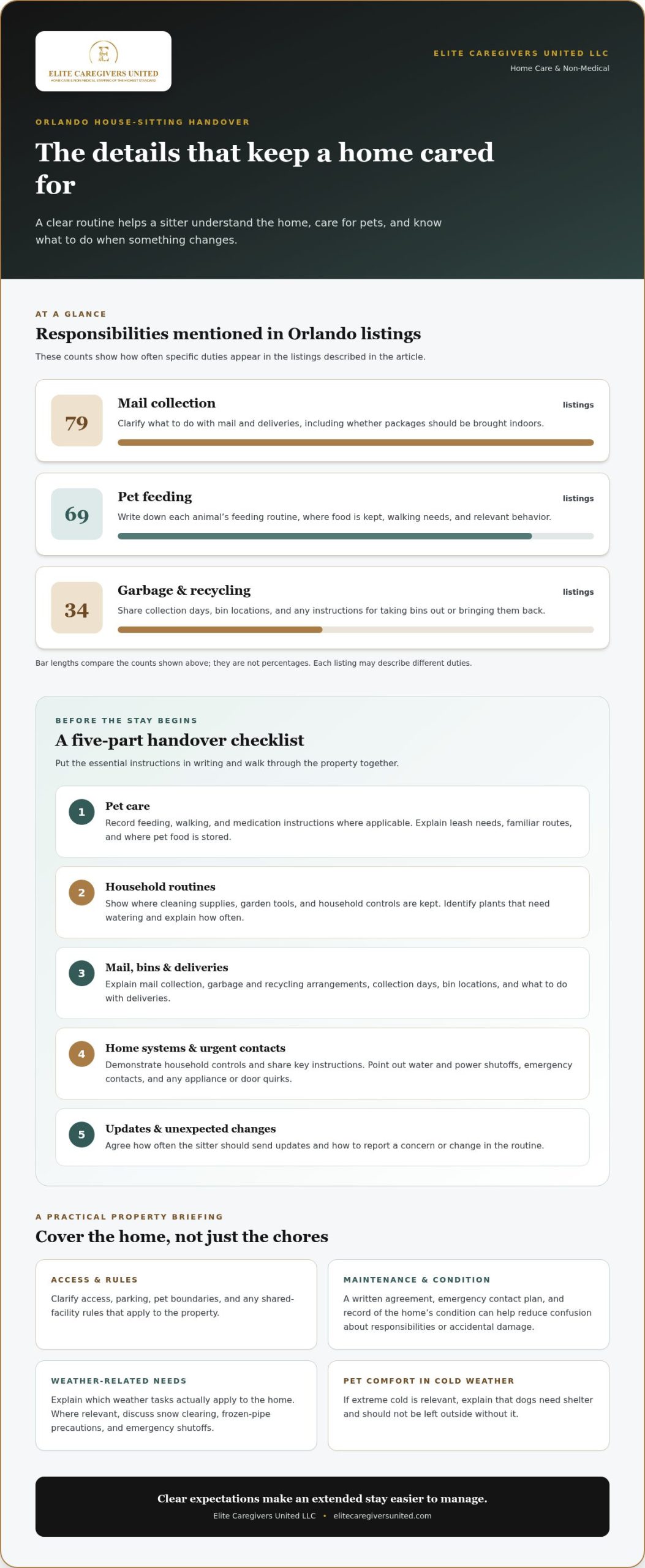
For long-term house sitting in Orlando for snowbirds, agree on the care routine before you leave. A written handover helps the sitter understand the property, daily tasks, and whom to contact if something changes. Include pet instructions, plant needs, household systems, and how often you’d like updates.
What risks should homeowners consider when leaving an Orlando home occupied long term? Regular occupancy can mean wear, accidental damage, missed maintenance, or confusion about access and responsibilities. A clear agreement, emergency contact plan, and record of the home’s condition help reduce misunderstandings.
Pet duties should be described as specific actions, not broad promises. In 69 Orlando house-sitting listings, pet feeding appears as a responsibility. Note each animal’s feeding routine, food location, walking needs, and any behavior that affects care. For example, explain whether a dog needs a leash for every walk or has a familiar route.
Care also extends beyond animals. Mail collection appears in 79 Orlando listings, while garbage and recycling appear in 34. Owners can clarify collection days, bin locations, and what the sitter should do with deliveries. If plants need attention, identify which ones require watering and how often, rather than leaving a general instruction to care for the garden.
Household systems need a practical handover. Before leaving, show the sitter how to operate the heating system safely and where to find key instructions. Identify water and power shutoffs and the contact for urgent property concerns. Notes about unusual sounds, appliance quirks, or doors that need extra care can prevent avoidable confusion.
Winter conditions matter wherever a sit takes place. Sitters should understand basic tasks such as clearing snow, watching for frozen pipes, and locating emergency shutoffs. Dogs in extreme cold need shelter and shouldn’t be left outside without it. For an Orlando home, explain which weather-related tasks apply to the property.
A useful handover can cover these points:
- Write down pet feeding, walking, and medication instructions, where applicable.
- Show where food, cleaning supplies, garden tools, and household controls are kept.
- Explain mail, garbage, recycling, and delivery arrangements.
- Share emergency contacts and the locations of water and power shutoffs.
- Agree on how the sitter will report a concern or unexpected change.
Clear expectations make the stay easier for owners and sitters. Specify whether a small garden needs watering, whether packages should be brought indoors, and how often you’d like updates. These details help keep pet care consistent and the home maintained during an extended absence.
Want More House Sitting Information?
A sitter’s profile and direct conversations help homeowners assess whether an arrangement fits their home, pets, and winter dates. Retirement, experience, availability, and clear expectations all help define the match.
Sitter Profiles and Homeowner Contact
A sitter profile summarizes someone’s background, experience, and availability, giving homeowners a starting point for discussion. It can help identify relevant experience, while direct contact clarifies whether the day-to-day arrangement fits.
For example, Ann says she is 69, retired seven years ago, and worked as a nurse for more than 35 years. Those details describe her background, but homeowners still need to discuss the actual assignment: dates, pet routines, household duties, and how they’ll communicate during the stay. A useful first message can name the dates and describe the animals and property, then invite a focused discussion.
Availability deserves equal attention. One sitter says she is on a long-term sit in Oregon until October 14. A homeowner planning a winter absence can compare their own departure and return dates with the sitter’s stated commitments, then discuss any gap between assignments.
Insurance, Permits, and Local Rules
Insurance, permits, and community rules affect how the stay fits the property and its governing requirements. A sitter’s access, parking, or pool use may depend on policy terms or neighborhood conditions.
Review your insurance terms and any HOA or condominium rules, especially if the sitter is paid or will use shared facilities. Address parking, pets, pools, and neighborhood access in the written handover: specify an approved parking space, gate instructions, pet boundaries, and whether pool access is allowed. This gives the sitter practical guidance without assuming every Orlando property has the same rules.
Winter can shape both the sitter’s availability and daily routine. Ask how the sitter plans to spend free time, and agree on which hours remain dedicated to the home and animals. An Orlando listing described a home 30 minutes from Disney World, illustrating how location may influence a sitter’s plans. For families coordinating outings with children, Orlando amusement park caregivers can help support children during park visits.
Experience can also be discussed through concrete examples. One house-sitting author says he has cared for over 40 homes, alongside experience with cats, dogs, and a turtle. Ask which responsibilities those past stays involved, then compare them with your own needs. A sitter who has cared for animals may still need your exact instructions for feeding, access, and household routines.
How much does a long-term house sitter cost in Orlando? The cost of a house-sitting service depends on the arrangement, and you’ll receive a quote after making a request. Stay length, pet-care needs, and household duties can shape the arrangement. For private sits, agree on whether compensation or an exchange arrangement applies before confirming dates.
Before confirming, put the schedule, duties, access arrangements, and update preferences in writing. A clear record helps both parties understand the commitment, particularly when a winter stay lasts several months.
Florida house-sitting assignments
Florida house sits vary in duration, location, and the care expected from a sitter. Comparing examples helps homeowners understand how a long seasonal absence differs from a brief visit and what details to include when asking about a suitable stay.
Dates can define the whole arrangement. A Venice assignment runs from September 1 through December 31, 2026, covering part of the winter season. A Lake Worth Beach listing runs from September 1, 2026, through September 1, 2027, spanning a full year. These examples show why owners should match the start and end dates to their travel plans, rather than assuming every Florida listing follows the same winter calendar.
Location also changes the nature of a stay. A Tampa assignment asks the sitter to stay two blocks from Bayshore Boulevard, while its listed absence runs from December 22 through December 29. That shorter window differs from the Venice and Lake Worth Beach dates. The property’s location, access, and expected presence can matter as much as the length of the assignment.
Care duties range from routine check-ins to ongoing animal care. A Sanford listing asks for care of one older cat twice per day, with feedings about 8-12 hours apart. In Jacksonville, another assignment involves two fish and four cats. Rotonda West has a different arrangement, asking for a once-weekly check-in. Each example calls for a distinct schedule, so the sitter’s message should address the actual animals and cadence.
- Venice: September 1 through December 31, 2026; the assignment has 8 applicants.
- Lake Worth Beach: September 1, 2026, through September 1, 2027; the assignment has 11 applicants.
- Sanford: One older cat needs care twice daily, with feedings about 8-12 hours apart.
- Rotonda West: The listing asks for a once-weekly check-in.
Applicant numbers offer context, not a measure of fit. Venice’s 8 applicants and Lake Worth Beach’s 11 show that multiple sitters may be considering an assignment. A focused introduction can help: state the dates you can maintain, describe relevant experience, and respond directly to the listing’s duties.
Other examples illustrate how sharply requirements can change. A Bradenton listing sought care for three small dogs for a week in July 2024. A Rotonda West home asked for weekly visits instead of a continuous stay. For homeowners, these contrasts make it useful to explain whether the sitter must remain at the property, provide scheduled visits, or follow a particular animal-care routine. The clearer the message, the easier it is to compare the assignment with a sitter’s availability and make expectations understood before agreeing.
Listing dates and durations
Snowbirds in Canada, the northern United States, and northern European countries typically leave in November and return in April. They may start looking for winter house sitters as early as July, leaving time to compare dates, duties, and travel plans.
The stay length should match the absence, not simply the season. The average snowbird is away from home for 4-6 months, but individual travel plans vary. Start by writing down departure and return dates, then compare them with each listing’s exact start and finish. A gap at either end may affect who can care for the property.
Short listings show why the word “winter” doesn’t automatically mean a months-long assignment. One Orlando home with a tropical pool and spa lists a stay of 4 nights, from Tuesday, November 24, 2026, to Saturday, November 28, 2026. Another listing near downtown Orlando, for a home with a quiet, healthy cat, runs 3 nights, from Tuesday, December 22, to Friday, December 25, 2026.
Those examples can suit brief travel, but they don’t cover a seasonal absence. A longer sit is illustrated by a homeowner endorsement recording Craig’s stay from December 1, 2023, to March 18, 2024. Comparing that span with your own plans helps clarify whether one continuous arrangement matches your living situation or whether dates need adjustment.
When should snowbirds start looking for an Orlando house sitter for winter? Start as early as July, since winter departures commonly begin in November. An early start gives you time to compare coverage for your full dates and discuss the home’s routines before travelling.
Use a calendar to assess each listing rather than relying on phrases such as “winter sit” or “long stay.” Record the listed dates, your travel dates, and any days when the home needs care before you leave or after you return. For example, a November-to-April absence may not align with a listing that ends in March, so date overlap matters more than the season label.
- Write down your departure and return dates before reviewing listings.
- Compare the complete assignment period with your travel calendar.
- Ask about any uncovered days and decide how they affect the arrangement.
- Include pet routines and household duties when considering a stay’s length.
Exact dates also help clarify commitment. A 4-night Orlando listing calls for a different schedule than Craig’s December-to-March sit. If a listing fits only part of your absence, treat that as a separate planning decision, not as full-season coverage. A clear calendar keeps the proposed stay aligned with your travel and home-care needs.
Orlando house-sitting availability
Orlando’s listings include 107 individual providers and 2 agencies or companies. That gives snowbirds more than one type of arrangement to consider, but availability depends on dates, location, and the care requested.
How do house sitting, home watch services, and vacation rentals compare for snowbirds in Orlando? House sitting generally pairs a sitter’s stay with agreed home or pet duties; home watch focuses on property checks, while a vacation rental provides temporary accommodation. The right fit depends on whether you need someone living at the property, periodic visits, or a place to stay.
Which house-sitting websites and services cover Orlando, Florida? Current Orlando listings include 107 individual providers and 2 agencies or companies. Those figures describe listing availability, not the number of people free for your exact dates, so search results need to be narrowed by schedule and responsibilities.
Consider a listed Orlando home described as 1,700 square feet, with three bedrooms and two bathrooms, and 30 minutes from Disney World. That example shows why a citywide search can hide important differences. A sitter may be suitable for one neighborhood or property but not another, particularly when daily pet care or a specific arrival date is involved.
For a multi-month stay, an agreement should make the arrangement clear to both sides. What should an Orlando house-sitting agreement include for a multi-month stay? Set out the start and end dates, whether the sitter stays overnight, assigned home and pet duties, access instructions, communication expectations, and any compensation or exchange terms.
A longer agreement should also explain what happens if travel dates change. State how either party will communicate a schedule change and how keys, gate access, and household instructions will be handled at the end. Written details help prevent different assumptions about whether a sitter may host guests, use shared spaces, or leave during the day.
Availability is more than a provider count. Use your travel calendar to narrow the search, then compare each listing against the actual needs of the home. A short sit may suit a brief absence, while an extended stay calls for someone whose dates and routine align with yours. For ongoing home care, explore house-sitting support as one option.
Before committing, summarize the essentials in one written document. Include emergency contacts, animal-care instructions, property access, and agreed updates. A clear record gives the sitter a practical reference and helps owners understand what the arrangement covers throughout the stay.
Elite Caregivers United: Respite Care
Elite Caregivers United LLC offers Respite Care for families who need temporary support caring for a loved one. If you’re planning an extended winter trip and a family caregiver needs relief, respite care can help meet that need while your household arranges care.
Personal Care Services/CNA Team can support someone who needs help with personal care. For families managing a return home after surgery, Surgery Recovery & Post-Hospitalization Care and Cosmetic Surgery Recovery may be relevant options. These services address care needs, rather than replacing a house sitter’s home and pet responsibilities.
Choosing support starts with identifying who needs care and what assistance would help your family. Contact Elite Caregivers United LLC to discuss care services that may suit your situation.
Plan the Support That Makes Your Stay Easier
Planning long-term house sitting in Orlando for snowbirds also means thinking about the people who remain at home. If a family member needs support while you travel, consider what would help them maintain comfort and daily routines. House care and personal care address different needs, and arranging each thoughtfully can make your winter plans more manageable.
Elite Caregivers United offers Respite Care, Personal Care Services/CNA Team, and Surgery Recovery & Post-Hospitalization Care. These services may suit a family caregiver who needs relief, someone who needs help with personal care, or a household planning for recovery support. Discuss the kind of assistance your family needs with Elite Caregivers United.
Contact Elite Caregivers United today to talk about care support for your family. With a thoughtful plan in place, you can move toward your seasonal stay with greater clarity and peace of mind.
Frequently Asked Questions
What is a Snowbird?
A snowbird is someone who leaves a colder northern region for a warmer place during winter. The term often describes retirees or business owners who spend the season in a warmer climate, then return home. For example, someone who leaves a northern U.S. home for a winter stay in Orlando fits the seasonal pattern. Their absence may shape the household and pet care they arrange.
Why House Sit in Winter?
House sitting can pair a homeowner’s seasonal absence with someone staying at the property and handling agreed responsibilities. For a snowbird with a dog, that could mean keeping the pet in its familiar home rather than arranging a kennel stay. A sitter’s presence may also help maintain everyday household routines. The arrangement works best when both parties share clear expectations about care, access, and communication.
What long-term house-sitting options are available in Orlando for snowbirds?
Orlando options include arrangements with individual sitters, agencies, or companies, as well as alternatives such as periodic home checks or vacation rentals. For long-term house sitting in Orlando for snowbirds, the key distinction is whether someone stays in your home and handles agreed duties or simply visits to check the property. Choose based on whether your priority is ongoing occupancy, pet care, or a place to stay yourself.
How can snowbirds find and vet a reliable Orlando house sitter?
Start with listings that match your dates, then compare each sitter’s experience with your household’s needs. Ask about similar responsibilities, such as caring for a shy cat or managing access to a gated community. Talk before agreeing, and discuss communication preferences, emergency decisions, and backup plans. A brief video walkthrough can also clarify rooms, entrances, and household routines.
What duties do Orlando house sitters typically handle, including pets, mail, and pool care?
Duties depend on the agreement and property. A sitter might feed pets, bring in mail, take bins out, or follow instructions for pool access. Don’t assume pool cleaning or equipment operation is included; describe any expected task clearly and explain relevant controls. For pets, provide written feeding and walking instructions, along with details about behavior or household boundaries. A specific task list distinguishes essential duties from optional ones.
Which house-sitting websites and services cover Orlando, Florida?
Orlando house-sitting listings include 107 individual providers and 2 agencies or companies.
What local Orlando rules apply to parking, pets, pools, and neighborhood access for house sitters?
Review your insurance terms and any HOA or condominium rules. In the written handover, specify the approved parking space, gate instructions, pet boundaries, and whether pool access is allowed.