

A familiar national name may feel like the safest choice, but the right care depends on more than brand recognition. When weighing local caregiver agencies near me vs national brands, Orlando families are comparing practical questions: who coordinates support, how the family stays informed, and whether the services fit the loved one’s daily routine.
Those details matter because dependable routines and a trusted relationship can help a loved one feel more comfortable at home. Before choosing an agency, consider what support is needed, when it’s needed, and how the family wants to be involved.
This guide explains how to compare local agencies and national brands, from communication and care coordination to service scope. Use the examples and checklist to compare personal care, respite, memory-related support, and recovery assistance against your loved one’s everyday needs.
Key Takeaways
- Local agencies focus on particular communities, while national brands have broader reach. Neither model guarantees a better fit for every family.
- When comparing local caregiver agencies near me vs national brands, find out who coordinates support and how family communication works.
- Compare service fit, caregiver continuity, communication, and the boundaries between non-medical care and clinical services.
- Match the agency model to your loved one’s needs, preferred schedule, and daily routines rather than choosing by brand size alone.
- Elite Caregivers United provides Orlando families with non-medical personal care, respite, and specialized support through a professional CNA team.
Local caregiver agencies near me in Orlando: what families are comparing
Choosing care often happens while a family is adjusting to a health change, a new routine, or added responsibilities at home. Agency descriptions can use similar terms without explaining who provides support or what that support looks like day to day. For Orlando families weighing local caregiver agencies near me vs national brands, compare the actual services and arrangements rather than assuming one label signals a better fit.
A local agency serves a particular community, such as Orlando. A national brand has a broader organizational reach, though local offices and operating arrangements can vary. Neither size alone tells you about care quality, caregiver continuity, or suitability for your family. Also distinguish an agency, which arranges care, from an independent caregiver hired directly by a family and an online directory, which may list agencies or individuals without providing care itself.
What does a local caregiver agency provide in Orlando?
A home care agency arranges non-medical assistance in a person’s home. Depending on the services provided, that may include respite for a family caregiver, help with daily living activities, or assistance during recovery after a hospital stay or surgery. Home care services cover different kinds of support, so compare what each service includes with the tasks your household needs help managing.
For example, an Orlando household may be looking for help with a morning routine, companionship during the day, or assistance that lets a loved one stay in familiar surroundings. When comparing agencies, describe the routine in practical terms: what help is needed, at what part of the day, and what preferences matter to the person receiving care. That makes it easier to assess whether the service fits, rather than relying on a broad label such as “senior care.”
What does a national home care brand typically represent?
A national brand generally has a wider footprint, which may include locations in multiple regions and shared organizational systems. That doesn’t explain how a particular local office handles caregiver matching, communication, or coordination. A directory is different: it helps people find listings, but it isn’t automatically responsible for arranging care.
For an Orlando family, the useful comparison is between the local support and working relationship each agency describes, not just the company’s size or name recognition. Agency reach describes scope, not the personal fit of care. Consider whether the assistance suits your loved one’s needs, the family’s involvement, and the rhythm of the home. Orlando-based Elite Caregivers United provides non-medical home and personal care through a professional CNA team, including respite, daily living assistance, and support for recovery and memory-related conditions. These services support daily well-being, not skilled nursing or clinical procedures.
Local versus national caregiver agencies: how coordination and reach differ
Agency size can shape how care is organized, but it doesn’t tell the whole story. A local office may bring a community-focused perspective, while a national organization may have a wider network or shared systems. Treat these as possibilities to explore, not promises about communication, coordination, or caregiver continuity.
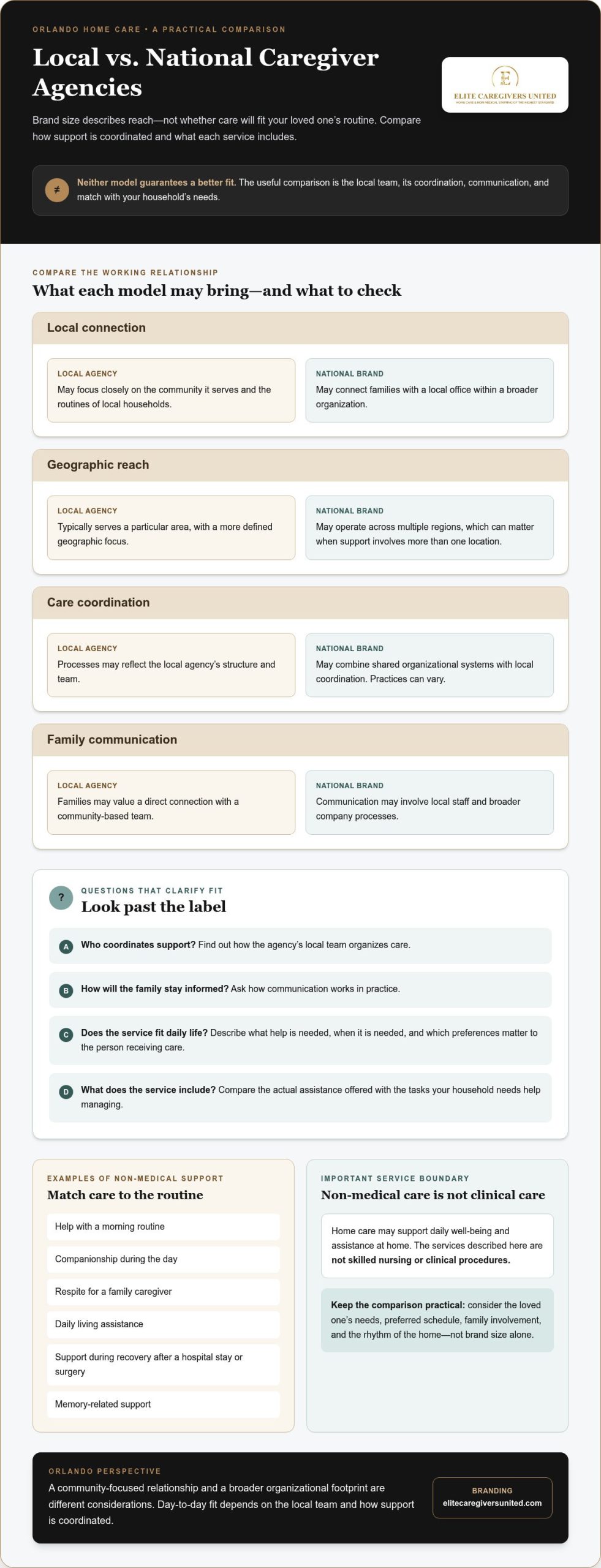
Use the comparison below to identify what matters in your household. Then look beyond the brand name and compare how each local team would fit care into your family’s routine.
| Factor | Local agency | National brand |
|---|---|---|
| Local connection | May focus closely on the community it serves and the routines of local households. | May connect families with a local office within a broader organization. |
| Geographic reach | Typically serves a particular area, with a more defined geographic focus. | May operate across multiple regions, which can matter when needs involve more than one location. |
| Coordination | Processes may reflect the local agency’s structure and team. | May combine shared organizational systems with local coordination. Practices can vary. |
| Family communication | Families may value a direct connection with a community-based team. | Communication may involve local staff and broader company processes. |
Where local agency relationships may help families
Community-based care can make a household’s everyday context part of the conversation about support. An Orlando family might explain when a loved one prefers help getting ready, which parts of the day feel most tiring, or how care should fit around a relative’s visits. These details help the family describe what assistance would be useful. They don’t guarantee a particular caregiver or uninterrupted continuity, so compare how the agency handles coordination and family communication.
When a national brand’s broader reach may matter
Families coordinating support in more than one city may value a wider organizational footprint, especially when they want to explore services under a recognizable name across locations. Still, scale and local care are different things: the day-to-day experience depends on the team providing support and how it is coordinated in that community. For Medicare-certified home health agencies, Medicare’s Care Compare tool offers a way to review agency information. It isn’t a substitute for comparing non-medical home care arrangements.
The right model depends on whether local continuity or broad reach matters more to your family. In either case, compare who coordinates care, how family updates are handled, and whether the services fit the person’s needs. For more detail on the scope of non-medical home care in Orlando, review how personal support can fit into daily life. Families exploring local care can also learn about Elite Caregivers United’s Orlando home care.
How to compare Orlando caregiver agencies beyond brand size
A polished listing or familiar name doesn’t show whether an agency’s support fits your loved one’s daily life. When comparing local caregiver agencies near me vs national brands, focus on the details that shape care: what help is provided, how the family stays informed, and what falls outside the service’s scope.
Use this checklist to compare the support each agency describes. For a more useful comparison, write down your answers for each option rather than relying on a general impression of the brand:
- Service fit: Is the main need respite, personal care, recovery support, or assistance for someone living with memory-related changes?
- Communication: Is it clear who coordinates support and how family updates are handled?
- Continuity: Does the description explain how care is organized around the person and their routine? Don’t assume continuity based on the brand name.
- Scope: Is the distinction between non-medical daily support and skilled nursing clear?
Online reviews can give context about other families’ experiences, but they’re only one signal. A review may reflect a different caregiver, household, or set of needs. Look for details relevant to your situation, then compare those impressions with the agency’s service descriptions and coordination practices. Broader challenges in the home care industry, including workforce pressures discussed in a U.S. Department of Health and Human Services brief, provide context but don’t establish what an individual agency’s care will be like.
Match the agency’s services to the family’s needs
Start with the reason you’re seeking support. A family caregiver who needs time to rest may prioritize respite. Someone who needs help with everyday activities may look for personal care. A household adjusting after surgery may need recovery assistance. If memory changes are central, consider support focused on familiar routines and daily assistance. Elite Caregivers United provides non-medical home care through a professional CNA team, including respite, personal care, and specialized support. Families considering memory-related support can learn about Alzheimer’s and dementia home care in Orlando.
Care boundaries matter as much as service names. Non-medical caregivers can support daily living and comfort, but they don’t provide skilled nursing or clinical procedures. If a need involves clinical treatment, don’t mistake a home care description for medical care. Understanding the service scope helps families form a realistic picture of the support available.
Compare communication, continuity, and scope
Before comparing agencies, write down the routines and preferences that would help care feel comfortable: a preferred time to get up, familiar activities, or the family member who should receive updates. Then compare how each agency describes coordination around those details. Compare service fit, communication, continuity, and scope, not brand size alone. This framework helps you judge whether the described support aligns with your family’s priorities.
Which caregiver agency model fits your Orlando family’s situation?
The choice becomes clearer when you start with the care situation rather than the agency’s size. For either model, use the same four steps: identify the need, define the schedule, set care boundaries, and compare the services with the household’s priorities.
- Name the need. Is the priority respite for a family caregiver, help with daily living, recovery support, or assistance related to a memory condition?
- Define the schedule. Note when support would be most useful, such as mornings, time at home after a hospital stay, or more continuous assistance.
- Identify care boundaries. Separate non-medical caregiving from any skilled nursing or clinical needs.
- Compare service fit. Consider how the described support could work with the person’s routine and the family’s involvement.
This process can also address a common concern: does choosing a local agency mean having fewer types of support to consider? Local doesn’t automatically mean limited. In Orlando, Elite Caregivers United provides non-medical personal care, respite, recovery assistance, memory-related support, and 24-hour home care. Focus on whether the services fit the situation, not whether the agency has a national name.
For families seeking respite or daily living assistance
If a relative provides care throughout the day, respite can provide support at home while that family caregiver rests or manages other responsibilities. For someone who needs help with daily living, look for clear descriptions of practical assistance rather than broad phrases that leave you guessing. Consider the household’s routines: support may need to fit around preferred mealtimes, familiar activities, or the way the person likes to begin the day. This is non-medical caregiving focused on daily comfort and assistance.
For recovery or specialized ongoing support
After surgery or a hospital stay, a person may need practical help at home while resuming everyday routines. That support is different from clinical treatment. It can complement the family’s broader care arrangements without replacing skilled medical services. Families may also be considering ongoing assistance for someone living with Alzheimer’s or dementia, Parkinson’s disease, or recovering from stroke or cancer. In each situation, focus on the daily help needed and how it can fit into the person’s home life.
For households considering more continuous assistance, 24-hour home care in Orlando is one option. Local and national models may each suit different circumstances; the fit depends on the service need, schedule, scope, and family preferences. Explore Orlando home care with Elite Caregivers United as you consider support for your loved one at home.
Choosing local caregiver support in Orlando: how Elite Caregivers United helps
For families comparing care options, the most useful question is how support will fit the loved one’s needs and the family’s day-to-day life. Elite Caregivers United is an Orlando-based, Florida-licensed agency providing non-medical home and personal care through a professional CNA team. Its local focus gives Orlando families a community-based option for practical support at home.
The choice between local caregiver agencies near me vs national brands is about fit, not size alone. Your family may need respite for the person providing daily care, help with personal routines, or more continuous assistance at home. Elite Caregivers United provides respite, personal care, specialized support, and 24-hour home care for different household needs. The appropriate support depends on the person’s circumstances and the family’s priorities.
A local approach to daily care and family support
Based in Orlando, Elite Caregivers United serves families in its local community. Respite care provides support at home while a family caregiver takes time for personal responsibilities or rest. Personal care assists with everyday needs, and families can describe what matters in familiar terms, such as getting ready or maintaining a comfortable routine. Thoughtful caregiving respects the person’s dignity and preferences while giving families a professional support team as part of their care arrangements.
Each household has its own rhythm. One family may need help during a particular part of the day; another may be looking for broader coverage at home. Elite Caregivers United’s 24-hour home care can support households considering continuous caregiving, while respite or personal care may better suit other needs. These options serve different purposes. Start by identifying the support you want to arrange instead of assuming one schedule or service works for everyone.
Specialized support within clear care boundaries
Elite Caregivers United provides non-medical caregiving support for people living with Alzheimer’s disease or dementia and Parkinson’s disease, as well as people recovering from stroke, cancer, surgery, or hospitalization. This support includes assistance with daily living and practical routines at home as part of the family’s broader care arrangements. It does not include skilled nursing, clinical procedures, or physical therapy. Keeping that boundary clear helps families distinguish caregiving from clinical treatment.
As you compare agency models, return to the details that matter most: the assistance needed, the preferred routine, and the support the family wants at home. A conversation is a practical first step for discussing those priorities. Discuss compassionate caregiving support with Elite Caregivers United.
Take the Next Step Toward Care That Feels Right
Choosing between local caregiver agencies near me vs national brands doesn’t need to be about finding the perfect label. Picture what a reassuring day at home would look like for your loved one, then consider what support could help make that routine possible. Your family’s needs may change, and a thoughtful care discussion can help you approach those changes with greater clarity.
Elite Caregivers United is an Orlando-based, Florida-licensed agency with a professional CNA team providing non-medical personal care, respite, and 24/7 home care. Whether you’re beginning to explore care or refining support already in place, identify what matters most to your household and discuss a suitable path forward.
Discuss compassionate caregiving support with Elite Caregivers United. Start a conversation about care that respects your loved one’s comfort, dignity, and daily life.
Frequently Asked Questions
What is the difference between a local caregiver agency and a national brand?
A local agency focuses on a defined community, while a national brand operates across a broader organizational footprint. The label doesn’t tell you who will coordinate care or how support will work in your household. A national company may have a local office, while a directory may simply list providers. Look for clarity about which organization arranges the care.
Are local caregiver agencies in Orlando licensed in Florida?
“Local” by itself doesn’t establish a provider’s licensing status. Families can use Florida’s Agency for Health Care Administration (AHCA) resources to look up an agency and confirm the record matches the business they’re considering. Elite Caregivers United is a Florida-licensed agency based in Orlando. Licensing is one part of understanding an agency; it doesn’t describe the services or daily experience a family can expect.
Can a caregiver agency help with non-medical care after a hospital stay?
Yes. Non-medical home care can help someone manage everyday activities after a hospital stay, such as personal care, companionship, and practical support around the home. Write down the routine that may be hardest to manage, such as getting dressed or moving through the day. Caregivers don’t provide skilled nursing or clinical procedures, so medical instructions and treatment remain with the appropriate health professionals.
What should families expect during the first in-home caregiver visit?
The first visit is generally an opportunity to discuss the person’s preferences, home routine, and everyday support needs. Prepare helpful details, such as how the person likes to be addressed, preferred mealtimes, mobility considerations, and activities that bring comfort. Sharing specifics makes it easier to discuss practical support. Use the visit to clarify roles and communication expectations.
Can a caregiver accompany a family member outside the home in Orlando?
Yes, caregiver support can include companionship outside the home. Elite Caregivers United offers travel companion services and caregivers or nannies for families visiting Orlando amusement parks. A family might value an extra companion during an outing so a loved one can participate with support. This is caregiving and companionship, not medical treatment. Consider the person’s comfort, outing plans, and everyday assistance needs when planning this kind of support.
Does Medicare pay for non-medical home care?
Original Medicare generally doesn’t cover ongoing personal care when that’s the only assistance a person needs. Medicare coverage for home health services is subject to specific eligibility and care requirements, and isn’t the same as paying for routine help with daily activities. Because coverage can depend on the person’s circumstances and plan, review current benefits with Medicare or the plan administrator before making financial arrangements for non-medical home care.