

What if your loved one could receive steady support at home, including while family members rest? For Orlando families concerned about overnight safety or gaps in care, a 24 hour in home caregiver can provide help throughout the day and night, shaped around familiar routines and individual needs.
It’s understandable to want clarity before considering round-the-clock care. This arrangement commonly involves caregivers working in shifts, while live-in care generally involves a caregiver residing in the home. Knowing the difference can help you identify which approach may fit your loved one’s needs and your family’s routine. In-home caregiving can include personal care, assistance with daily activities, and companionship. It is non-medical support, distinct from skilled nursing or clinical treatment.
In this article, you’ll learn when continuous support may be appropriate, what caregiving can look like throughout the day, and how it differs from other arrangements. We’ll also cover how to prepare for care and how a professional CNA team can help Orlando families share caregiving responsibilities while preserving comfort, dignity, and peace of mind.
Key Takeaways
- A 24 hour in home caregiver arrangement can help families plan support for needs that arise during daytime and overnight hours.
- Personal care, companionship, and practical daily assistance can be shaped around a loved one’s preferences and routines.
- Understand how 24-hour care, live-in care, and overnight care differ before deciding which arrangement may fit your family.
- Mapping daily routines, personal-care needs, household details, and communication preferences can make care planning clearer.
- Elite Caregivers United’s professional CNA team provides non-medical personal care and daily living support for Orlando families.
When an Orlando Family May Need a 24-Hour In-Home Caregiver
Coordinating care at all hours can be exhausting. A family member may be meeting a loved one’s needs while keeping up with work, household responsibilities, and their own need for rest. A 24 hour in home caregiver arrangement provides support across the day and night, helping address needs as they arise instead of relying on one relative to remain constantly on call.
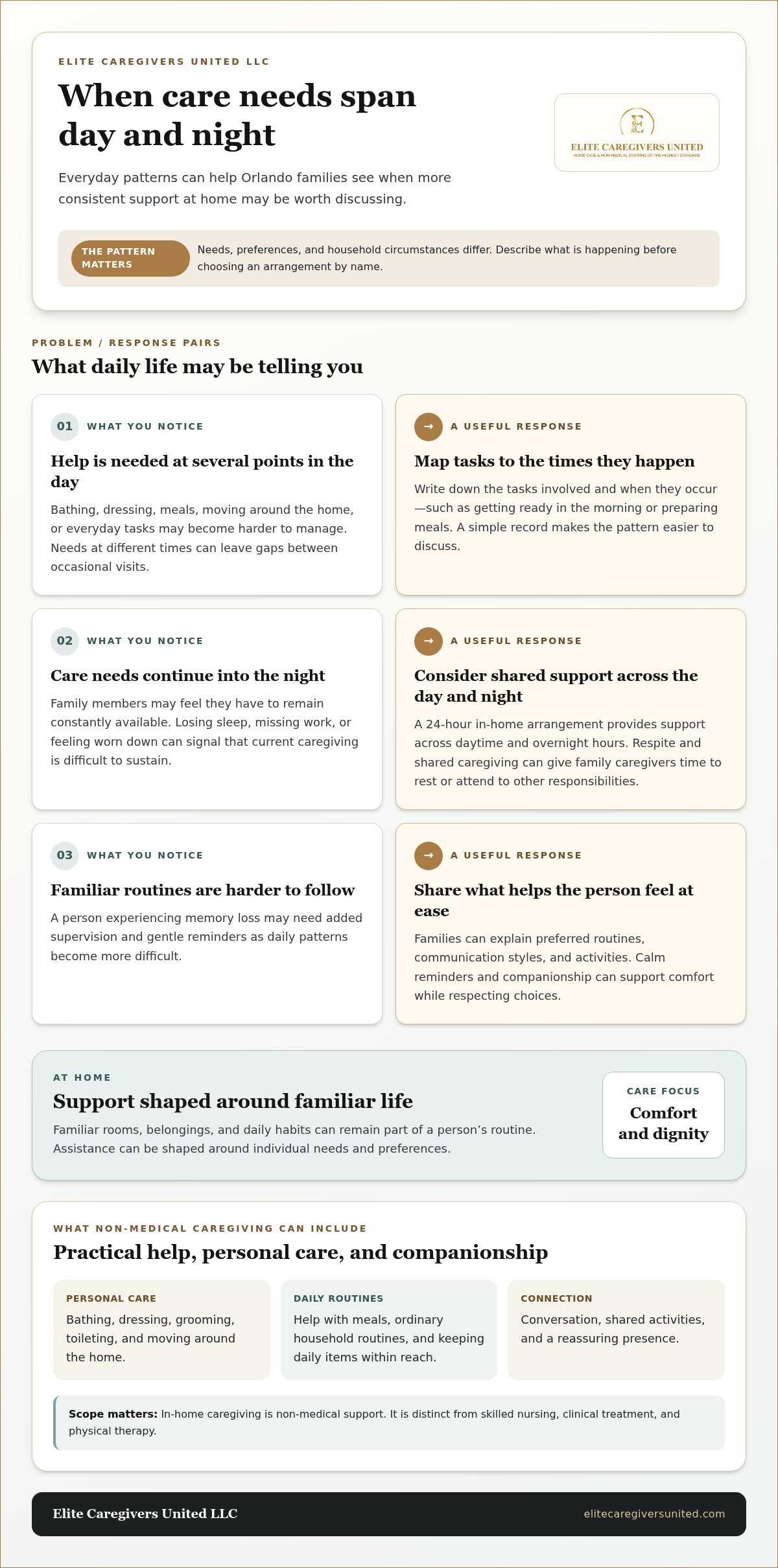
The need for more consistent help often becomes clearer through everyday patterns. A loved one may need assistance at several points during the day, or family members may find that care demands extend into the night. These observations can prompt a conversation about support, but they don’t automatically mean one particular arrangement is right. Needs, preferences, and household circumstances differ from person to person.
Everyday signs that more consistent home support may help
Notice which routines are becoming harder to manage. Someone may regularly need help bathing, dressing, preparing meals, moving around the home, or keeping up with everyday tasks. If these needs arise at different times, occasional help may leave gaps. Write down the tasks involved and when they occur, such as getting ready in the morning, preparing meals, or needing assistance overnight. A simple record makes the pattern easier to discuss.
Family capacity matters, too. If relatives are losing sleep, missing work, or feeling worn down by being available at all hours, respite and shared support may make caregiving more sustainable. A person experiencing memory loss may also benefit from added supervision and gentle reminders when familiar routines become harder to follow. The goal is attentive, respectful support, not to assume that a diagnosis alone determines how much care someone needs.
Why families consider care at home in Orlando
Home offers familiar rooms, belongings, and daily habits. Receiving assistance there may help a person continue preferred routines, from eating at a usual time to spending time in a familiar living space. The broad idea of Home care includes support delivered where a person lives, with assistance shaped around individual needs.
Orlando families may also be balancing commutes, school schedules, other caregiving responsibilities, and time to recharge. When a loved one needs help throughout more of the day, dependable support at home can ease pressure on relatives while keeping the person’s preferences central. Families can also learn more about 24-hour home care in Orlando by discussing the daily schedule, the tasks that need support, and the hours when family members are available.
Start by describing what you observe: which tasks require help, when supervision is most important, and how family members are managing. For example, note whether support is needed at predictable points, such as mealtimes, or whether needs also arise overnight. This practical picture is a stronger starting point than choosing an arrangement by name alone.
What a 24-Hour In-Home Caregiver Can Help With
Support across the day and night can mean more than having someone nearby. A caregiver can assist with personal care, everyday routines, and companionship, while helping family members share caregiving responsibilities. Specific tasks depend on the person’s needs, abilities, preferences, and agreed care plan. For a family considering a 24 hour in home caregiver, clear communication helps keep support practical and respectful.
Personal care, companionship, and daily routines
Personal care may include help with bathing, dressing, grooming, toileting, or moving around the home. A thoughtful caregiver protects privacy, explains the assistance being provided, and encourages the person to do what they can independently. Small choices matter: a preferred outfit, a familiar morning routine, or enough time to get ready without feeling rushed can help preserve dignity.
Caregiving also includes human connection. Conversation, a shared activity, or a reassuring presence during a quiet part of the day can make home feel less isolating. Practical assistance may include help with meals and ordinary household routines, such as keeping daily items within reach. These are non-medical forms of support, not clinical treatment.
Consistent routines help caregivers and relatives understand what feels comfortable and what assistance is needed. Families can share preferences, changes in daily needs, and useful observations so support stays aligned. Respite care can also give family caregivers time to rest, attend to other responsibilities, or take a break while their loved one continues to receive assistance.
Support for memory care and recovery needs
For a person living with Alzheimer’s disease or another form of dementia, non-medical assistance may involve calm reminders, companionship, and help following familiar daily patterns. A patient, reassuring approach can support comfort without taking away choices. Families can share preferred routines, communication styles, and activities that help the person feel at ease.
After surgery or a hospital stay, caregiver support can complement a family’s recovery routine with help for personal care, meals, and everyday tasks at home. Families can explain the practical assistance their loved one needs and coordinate caregiving with instructions from the person’s healthcare team. A caregiver does not provide skilled nursing, clinical procedures, or physical therapy, and home care should not be presented as a substitute for those services. Senioridy’s overview of 24-Hour In-Home Care Costs and Types also describes different around-the-clock care arrangements.
Care needs can change, so families can share updates when routines or preferences shift. Elite Caregivers United provides non-medical personal care and daily living support through a professional CNA team. To discuss support for your family, explore 24-hour home care in Orlando.
24-Hour, Live-In, and Overnight Care: The Differences
Care arrangements can sound similar, but they describe different patterns of support. 24-hour care refers to assistance covering needs across a full day and night. Live-in care centers on a caregiver staying in the home, while overnight care focuses on help during nighttime hours. Understanding these distinctions can help families describe their needs clearly and choose a plan that reflects daily life, not just a label.
How continuous coverage differs from live-in or overnight support
The comparison below is a starting point rather than a fixed set of rules. Duties and coverage details depend on the individual care plan, the person’s routines, and the assistance they need. A 24 hour in home caregiver arrangement addresses support needs across daytime and nighttime periods, while live-in and overnight care may be organized around different household needs.
| Arrangement | Coverage focus | May suit a family considering | Points to consider |
|---|---|---|---|
| 24-hour care | Support across a full day and night | Help needs that may arise during both daytime routines and overnight hours | Which tasks need support, when they occur, and how coverage is organized in the care plan |
| Live-in care | A caregiver stays in the person’s home as part of the arrangement | Support connected to home routines and a caregiver’s presence in the household | How the arrangement addresses the person’s needs throughout the day and during nighttime hours |
| Overnight care | Assistance focused on nighttime hours | Families whose main concerns or support needs occur at night | Whether daytime needs also require a separate plan for assistance |
These terms don’t specify exact schedules, tasks, or staffing on their own. For example, a family might need help with daytime personal-care routines as well as assistance if the person wakes and needs support overnight. Another person may have a settled daytime routine but benefit from a reassuring presence during the night. Clarify the details and reflect them in an individualized plan.
Choosing an arrangement around the person’s needs
Begin by looking at when help is needed, rather than assuming one model is best. Consider personal-care routines, mobility around the home, companionship, and overnight concerns. Note which parts of the day the person prefers to manage independently and where assistance is welcome. Familiar routines and privacy matter, too. Care should respect the person’s comfort and choices.
Family capacity is part of the picture. Relatives may be able to help at certain times but need respite or support beyond those hours. A useful discussion brings together the person’s daily preferences, patterns of assistance, overnight needs, and the family’s ability to participate. Care can then be shaped around actual needs and household circumstances, with room to revisit the plan if routines or support needs change.
How to Prepare for 24-Hour In-Home Care in Orlando
Preparing for around-the-clock support is easier when the family can describe what a typical day looks like. You don’t need a perfect schedule or a lengthy document. A clear picture of the person’s preferences, assistance needs, and overnight concerns gives an individualized care plan a useful starting point and helps everyone coordinate.
Use this sequence to organize the conversation:
- Discuss current needs. Note personal-care tasks, everyday activities, and moments when your loved one welcomes assistance. Describe overnight concerns plainly, including the reassurance or practical help that may be needed.
- Map familiar routines. Write down usual wake-up and bedtime habits, meal preferences, favorite activities, and the person’s communication style. Include details that preserve comfort, such as a preference for quiet mornings or choosing clothes independently.
- Coordinate household details. Identify where everyday care items, clothing, meal supplies, and important household information are kept. Consider how the person moves through the home, and share relevant details about entrances, pets, or routines a caregiver should know.
- Plan family communication. Decide which relatives should receive updates and how the family will share changes in preferences or daily needs. Gather family and emergency contact information so important details are easy to find.
Information to gather before care begins
A short care profile can include the person’s preferred name, routines, interests, communication preferences, and areas where they welcome help. Note what they prefer to handle independently, too. Include relevant household information and contact details, and keep the profile organized so family members can update it as needs change.
Bring questions about personal care, respite for family caregivers, and support during daytime and nighttime hours into the planning conversation. If your loved one has preferences about privacy, conversation, meals, or how assistance is offered, explain them. These details help make care more personal than a task list alone.
Coordinating family communication and home routines
Choose a simple way for relatives to share observations, such as a shared written log or an agreed family update. Focus notes on practical changes: a different bedtime, new meal preferences, or more help with a familiar routine. Keep commonly used care items in a known place, and point out walkways or household arrangements that support comfortable movement around the home.
Families exploring 24 hour in home caregiver support can also learn about non-medical home care in Orlando. For an individualized conversation about your family’s needs, discuss 24-hour home care in Orlando with Elite Caregivers United.
How Elite Caregivers United Supports 24-Hour Home Care in Orlando
Families considering continuous support need more than a general list of tasks. They need care that recognizes the person behind those tasks, respects established routines, and gives relatives room to share caregiving responsibilities. Elite Caregivers United provides non-medical 24-hour home care in Orlando, helping individuals with personal care and daily living in the familiarity of home.
A professional team for personal care and respite
Care is delivered by a professional CNA team, supporting personal-care needs and everyday activities with attention to the individual’s preferences. Assistance can be shaped around the routines a person values, the help they welcome, and the ways they prefer to communicate. Respectful care means allowing time, protecting privacy, and recognizing that comfort and independence look different for each person.
Support can also provide respite for family caregivers. Knowing that a loved one has help with daily routines can give relatives time to rest or attend to other responsibilities while remaining part of the care conversation. Families can share useful context, such as which tasks are most challenging, what makes a routine feel familiar, and how their loved one prefers to receive assistance. These details help make support personal rather than one-size-fits-all.
The CNA team provides non-medical caregiving focused on personal care, companionship, and daily living support, rather than skilled nursing, clinical procedures, or physical therapy. Keeping this distinction clear helps families understand what an in-home caregiver provides and how caregiving can complement other support in a person’s life.
Discussing a care plan with an Orlando agency
A conversation about care can begin with what the family already knows. Describe the person’s usual routines, where help is welcome, daytime priorities, and concerns about nighttime support. It can also help to explain what the family hopes to maintain, whether that is a familiar morning routine, more time for companionship, or a sustainable way for relatives to share responsibilities.
Bring questions about personal care, respite, and support across the day and night. You don’t need to have every detail solved before beginning a discussion. Sharing observations and priorities can help clarify what individualized assistance may look like and where support could ease daily pressures. Care needs and preferences can change, so open communication remains valuable as the plan develops.
Elite Caregivers United provides 24-hour home care in Orlando through a professional CNA team, with non-medical support centered on daily living and personal care. If your family is ready to talk through your loved one’s needs and consider a care plan, discuss 24-hour home care in Orlando with Elite Caregivers United.
Take the Next Step Toward More Supported Days
Deciding whether a 24 hour in home caregiver is right for your family doesn’t require having every detail figured out. Begin with an honest conversation about what feels difficult now, what your loved one values, and what would make caregiving more manageable. A few notes about shared priorities can make that first discussion clearer and less overwhelming.
Care planning is a process, not a test your family has to pass. Your priorities may become clearer as you talk through them, and it’s reasonable to take things one step at a time. The aim is to build support around the person’s comfort and the family’s circumstances, while making space for questions along the way.
Elite Caregivers United helps Orlando families discuss care needs and consider an individualized next step. Discuss 24-hour in-home care with Elite Caregivers United, and begin shaping a plan with care and confidence.
Frequently Asked Questions
What does a 24-hour in-home caregiver do?
A 24-hour in-home caregiver provides non-medical assistance with personal care, everyday routines, and companionship across daytime and overnight needs. Families can explain which tasks matter most, such as help getting ready for the day or having someone nearby during evening routines. At Elite Caregivers United, care is provided by a professional CNA team and can be shaped around a person’s preferences and daily-living needs.
Is 24-hour in-home care the same as live-in care?
No. 24-hour in-home care describes support intended to cover needs across a full day and night, while live-in care describes an arrangement in which a caregiver resides in the home. The labels alone don’t explain every detail of coverage. Before planning, clarify which hours require assistance, what support is expected, and how the arrangement addresses times when the person needs help.
How much does a 24-hour in-home caregiver cost in Orlando?
The cost depends on the individual care plan, the type and frequency of assistance, and how coverage is arranged. Because families’ needs differ, a general figure may not reflect the support a particular person requires. To discuss an individualized plan with Elite Caregivers United, describe the daily routines, personal-care needs, overnight concerns, and respite priorities your family would like addressed.
Can a 24-hour caregiver help with dementia at home?
Yes. Non-medical in-home caregiving can support a person living with dementia through familiar routines, companionship, gentle reminders, and help with everyday personal care. Families can share preferred ways to communicate, activities the person enjoys, and situations that may cause distress. Elite Caregivers United provides Alzheimer’s and dementia care focused on daily living support while respecting the person’s dignity and choices.
Can a family arrange 24-hour care after a hospital stay?
Yes. In-home caregiver support can help a person manage everyday routines after a hospital stay, including personal care, meals, and practical assistance at home. Families can share the discharge plan and coordinate caregiving around instructions from the healthcare team. Elite Caregivers United offers surgery recovery and post-hospitalization care as non-medical support, helping families organize day-to-day assistance during the transition home.
Does 24-hour in-home care include skilled nursing?
No. 24-hour in-home caregiving from Elite Caregivers United is non-medical support and doesn’t include skilled nursing, clinical procedures, or physical therapy. Care may assist with personal needs and everyday activities, but it isn’t a substitute for clinical treatment. If a person’s care plan includes medical services, families should keep those arrangements coordinated separately with the appropriate healthcare professionals.
How can I arrange 24-hour in-home care in Orlando?
Start by discussing your loved one’s daily routines, the personal-care tasks where help is welcome, and any concerns about daytime or overnight support. Share communication preferences and what would give your family respite, too. Elite Caregivers United provides 24-hour home care in Orlando, and a conversation about these priorities can help your family explore an individualized plan for support at home.