

What if the most reassuring part of recovery is knowing who can help with everyday tasks? After breast augmentation, reaching, dressing, preparing meals, or getting settled at home may feel harder than expected. Thoughtful breast augmentation recovery care can make daily routines more manageable while you follow your surgeon’s instructions.
It’s understandable to wonder whether you’ll need help, how to ask family without feeling like a burden, or whether a caregiver can answer medical questions. A non-medical caregiver can support daily routines and offer companionship, but your surgeon and clinical team are the right people to guide treatment decisions and address concerns about symptoms.
This guide explains how to plan practical support around your surgical team’s directions, decide which tasks you may want help with, and discuss a schedule that fits your needs. It also covers what to clarify with family or a caregiver, what support can and can’t include, and when to contact your surgical team.
Key Takeaways
- Breast augmentation recovery care can support everyday routines while medical decisions and instructions remain with your surgical team.
- List the household tasks you may want help with, then tailor the plan to your needs and your surgeon’s guidance.
- Compare family help, professional assistance, or a combination to find an arrangement that feels dependable and comfortable.
- Prepare by confirming instructions, listing daily needs, arranging support, and sharing communication preferences.
- When exploring support in Orlando, ask about scheduling and available personal-care tasks, and clarify how a caregiver’s role fits around your clinical instructions.
What Breast Augmentation Recovery Care Can and Cannot Include
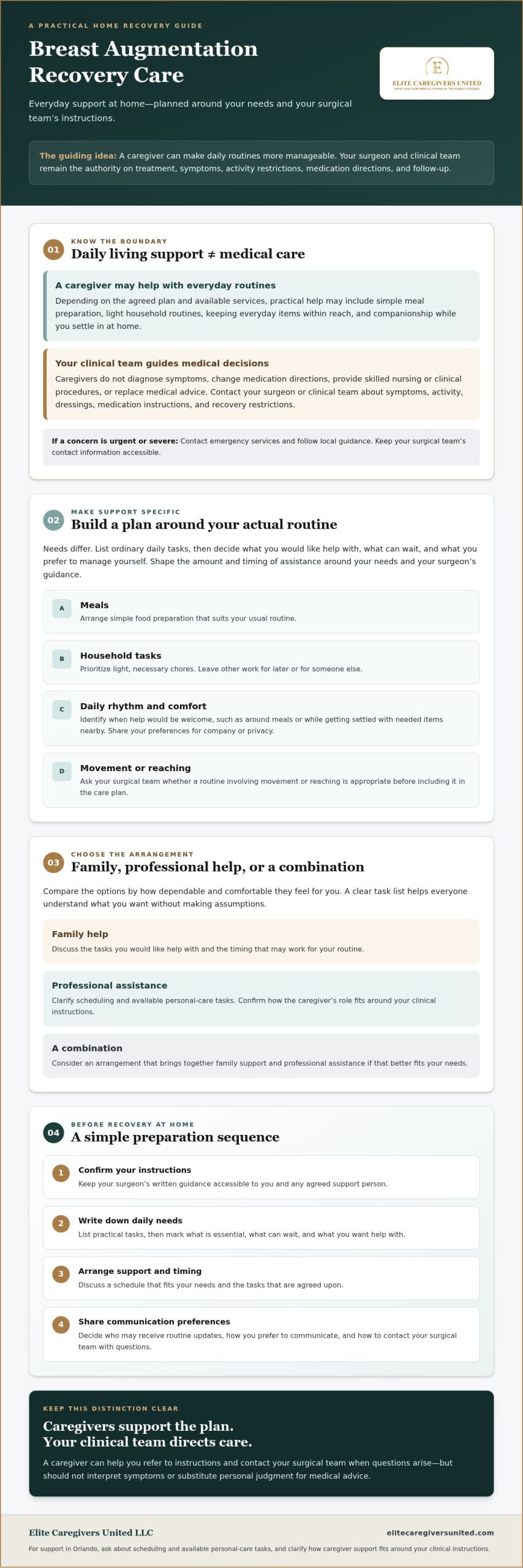
Breast augmentation recovery care means practical, non-medical help that can make daily life easier while you recover at home. The support should reflect your needs and your surgeon’s instructions, rather than follow a one-size-fits-all schedule. Your surgeon and clinical team set activity restrictions, medication directions, and follow-up plans. A caregiver can help organize everyday routines around that guidance.
A general overview of post-surgical recovery can provide background, but your clinical team is the authority on what applies to your procedure. Before surgery, consider which tasks might be difficult at home and share your list with the people who may help. Needs differ, so discuss the amount and timing of assistance for your individual situation.
What support at home may look like after breast augmentation
Depending on the agreed care plan and available services, support may include preparing simple meals, helping with light household routines, keeping everyday items within reach, or offering companionship while you settle in. If you expect to need help moving around, discuss the specific assistance with your surgeon first and make sure any caregiver understands the instructions you’ve received. Don’t assume a task is suitable simply because it seems routine.
Planning ahead makes it easier to ask for specific help. Write down practical tasks you handle each day, such as preparing food, tidying shared spaces, or getting settled in a comfortable resting area. Then mark which tasks you’d like someone else to take on and which you prefer to manage yourself.
Where caregiver support ends and medical care begins
A caregiver assists with daily living. Clinicians assess and treat medical concerns. Caregivers don’t diagnose symptoms, change medication directions, or provide skilled nursing or clinical procedures. They can help you refer to your surgical team’s instructions and contact the team when a question comes up, but they shouldn’t interpret symptoms or substitute their judgment for medical advice.
Contact your surgeon or clinical team with questions about symptoms, activity, dressings, medication instructions, or recovery restrictions. If a concern is urgent or severe, contact emergency services and follow local guidance. Keep the surgical team’s contact information accessible and share your preferred communication plan with anyone assisting you.
How a Recovery Caregiver Can Support Everyday Needs at Home
Help at home is most useful when it fits your actual routine. A caregiver may assist with practical tasks and companionship while you follow your surgical team’s directions. The American Society of Plastic Surgeons offers general information about breast augmentation recovery. For your individual restrictions and care instructions, rely on your own clinical team.
Planning assistance with meals, routines, and household tasks
Before surgery, make a short list of tasks that happen on an ordinary day. Mark what’s essential, what can wait, and what you’d prefer to handle independently. For example, a caregiver might prepare a simple meal, tidy commonly used areas, or help you get settled with needed items nearby. These are household supports, not clinical meal planning or a substitute for medical guidance.
Keep your surgeon’s written instructions accessible to you and any agreed support person. If a routine could involve movement or reaching, ask the surgical team whether it’s appropriate before including it in the care plan. A clear task list helps family members and caregivers understand what you want without making assumptions.
- Meals: Arrange simple food preparation that suits your usual routine.
- Household tasks: Prioritize light, necessary chores and leave other work for later or for someone else.
- Daily rhythm: Identify when help would be most welcome, such as around meals or while settling in at home.
Supporting comfort, companionship, and family communication
A calm, considerate presence can make time at home feel less isolating. A caregiver can offer conversation, help with agreed daily routines, and ask about practical needs without presenting those check-ins as clinical monitoring. You should feel comfortable saying what kind of company or privacy you prefer.
With your consent, a caregiver can help share routine updates with family or assist you in contacting the surgical team with questions. The caregiver doesn’t interpret symptoms or answer clinical questions. Those remain for the appropriate medical professionals. Agree in advance who may receive updates to protect your privacy and prevent confusion.
Support arrangements may be hourly, daily, or around the clock, depending on your needs and the agency’s availability. Not everyone needs the same schedule, so discuss the tasks and timing that would be most helpful. If you’re exploring cosmetic surgery recovery support, ask which personal-care tasks and scheduling options are available for your situation.
Family Help or Professional Breast Augmentation Recovery Care?
There isn’t one right arrangement for everyone. Family may be available for some tasks, a professional caregiver may fill specific gaps, or the two can share support in a way that respects your preferences. The Breast augmentation surgery overview from MedlinePlus offers general procedure information, but your surgeon should guide your recovery plan. A caregiver supports daily living. Hiring one doesn’t replace family involvement or clinical care.
Use this comparison to start a conversation, not as a ranking. Tasks and schedules depend on your household, the agreed services, agency availability, and your surgeon’s instructions.
| Arrangement | Availability | Task coverage | Continuity | Family coordination |
|---|---|---|---|---|
| Family-only help | Depends on relatives’ schedules | Tasks relatives agree to take on | May vary with work and other responsibilities | Family members divide and communicate tasks |
| Scheduled professional assistance | Arranged schedule, subject to availability | Agreed non-medical tasks within the service | Discuss how visits and updates are arranged | Coordinate preferences and instructions with the patient |
| Combined support | Shared between relatives and scheduled help | Tasks divided according to the care plan | Can provide planned coverage across different routines | Agree who handles each task and communicates updates |
When family support may be enough, and when to add help
Consider who can be present, what responsibilities they already have, and which daily tasks may need assistance. Family help may feel comfortable and familiar, but relatives may not be available for every planned task. Professional support is an option for filling practical gaps, not a medical necessity. If restrictions or care needs are unclear, ask your surgeon before deciding what help to arrange.
Questions to ask before arranging a caregiver
Before arranging support, ask which non-medical tasks are included and how the agency learns about your needs. Confirm possible scheduling arrangements, who to contact with service questions, and how updates will be shared with your consent. Ask how the caregiver will follow written instructions without interpreting them. Medication directions, symptoms, and clinical concerns remain matters for your surgical team.
For breast augmentation recovery care, a shared plan can help relatives stay involved without asking one person to carry every practical responsibility. List who will handle meals, household routines, and communication. Revisit the plan if needs or availability change.
How to Prepare for Breast Augmentation Recovery at Home
A thoughtful plan can make it easier to coordinate practical help without guessing about medical needs. Start by confirming your surgeon’s instructions. Then list the daily tasks you may want help with, arrange support, and agree on how updates and questions will be communicated. Your plan should reflect your household, preferences, and clinical guidance, rather than a standard schedule.
Ask the surgical team what activity restrictions to plan around and what information a support person should have. If you’re unsure whether a task is appropriate, ask before adding it to the plan. You can also place commonly used items within comfortable reach, following any guidance your team provides.
A planning checklist to complete before surgery
Use this checklist to start a conversation with family or a caregiver. Keep clinical instructions in your surgical team’s own words so practical planning doesn’t accidentally change their meaning.
- Save the instructions: Keep the team’s contact process, follow-up information, and written care directions accessible to you and the support person you choose.
- Name a family contact: Agree who will share routine updates, and confirm with whom information may be shared.
- List daily tasks: Note meals, household routines, and other practical needs, then identify which tasks you’d like help with.
- Plan support times: Discuss when assistance may be useful and what schedule fits your expected needs and preferences.
- Prepare essentials: Arrange frequently used items within reach if doing so is consistent with your surgeon’s guidance.
Coordinating home care with the surgical team
Before surgery, ask your surgeon what instructions a caregiver should know and which questions must go directly to the clinical team. Share only relevant directions with the person assisting you, and make sure they know where the current written instructions are kept. If guidance changes, update the support plan instead of relying on memory or an old note.
A caregiver can help with agreed daily routines and contact the surgical team at your request, but shouldn’t interpret restrictions or make medical decisions. Use your surgical team’s guidance to clarify what support is needed at home and who is responsible for each part.
If you’re arranging non-medical help in Orlando, discuss cosmetic surgery recovery support and ask which tasks and scheduling options may fit your plan.
Finding Breast Augmentation Recovery Care in Orlando
Arranging help in Orlando starts with a clear picture of the support you want at home. When discussing breast augmentation recovery care, share the expected timing, household routines that may need assistance, the schedule you’re considering, and relevant instructions from your surgical team. With your permission, those instructions can guide practical support. Medical questions and decisions remain with your clinicians.
What to discuss when arranging local recovery assistance
Describe the tasks you’d like help with, such as meal preparation, light household routines, or companionship, and explain when support may be most useful. Be specific about your preferences, too. For instance, say whether you’d like a family member included in routine updates and how you prefer questions to be relayed. This helps you discuss an arrangement that fits your household instead of assuming every patient needs the same plan.
Ask the agency about possible hourly, daily, or around-the-clock scheduling for the period you have in mind. Confirm options and availability directly, since a requested schedule may not always be available. You can also ask how the agency learns about individual needs and how relevant instructions, shared with your permission, will be made accessible to the caregiver.
- Timing: Share when you expect to need assistance and the schedule you’re considering.
- Daily needs: Name the specific household and personal-care tasks you want to discuss.
- Communication: Clarify who may receive updates and how the caregiver should contact you or your chosen family member.
- Clinical instructions: Provide relevant directions from your surgical team, and ask how the caregiver will follow them without interpreting or changing them.
How Elite Caregivers United LLC fits into a recovery plan
Elite Caregivers United LLC serves Orlando and offers cosmetic surgery recovery support and personal care through a professional CNA team. This is non-medical assistance with daily routines, arranged around your plan and preferences. Confirm directly which tasks are available and whether the schedule you’re considering can be accommodated.
Caregivers don’t replace your surgeon or clinical team, provide skilled nursing, or answer medical questions. Keep your surgical team responsible for symptoms, restrictions, medications, and follow-up. The caregiver’s role stays focused on agreed daily support.
If you’re considering help at home, discuss your needs and preferred schedule with Elite Caregivers United LLC to see whether its non-medical support may fit your recovery plan. Confirm availability and service details directly, since one arrangement won’t suit everyone.
Move Forward With a Support Plan That Fits
A dependable recovery plan doesn’t need to look the same for everyone. Start with your surgeon’s instructions, identify the everyday tasks where help would be welcome, and decide how family or a caregiver can share that support. Thoughtful breast augmentation recovery care can ease practical strain while keeping medical decisions with your surgical team.
In Orlando, Elite Caregivers United LLC offers cosmetic surgery recovery support and non-medical personal care through a professional CNA team. The business operates around the clock, but specific caregiver availability and scheduling should be confirmed directly. Discuss the tasks you have in mind, your preferred schedule, and how support can follow the instructions your clinical team provides.
If you’re exploring help at home, discuss recovery support with our Orlando team. A clear conversation can help you decide whether non-medical assistance fits your plan as you prepare to follow your surgeon’s guidance.
Frequently Asked Questions
What does a breast augmentation recovery caregiver do?
A breast augmentation recovery caregiver may help with agreed non-medical daily tasks, such as preparing simple meals, assisting with household routines, offering companionship, or helping you get settled at home. Specific support depends on your needs and the provider’s service plan. Caregivers don’t replace your surgeon, provide skilled nursing, or make medical decisions. Before arranging help, ask the agency which tasks it offers and share relevant instructions from your surgical team.
How long do you need help after breast augmentation?
There’s no single schedule or duration that works for everyone. The support you need can depend on your household, the tasks you usually manage, and your surgeon’s directions. Before surgery, ask your clinical team what kind of assistance to plan for, then consider when family or other support people are available. A care provider can discuss scheduling options, but shouldn’t predict how long your individual recovery will take.
Can a caregiver help with medication after breast augmentation?
A non-medical caregiver shouldn’t change, prescribe, or interpret medication directions. Follow the instructions from your surgeon or prescribing clinician, and keep them accessible at home. If you’re considering help with a medication-related routine, ask the agency what assistance is within its service scope rather than assuming it’s included. For a question about a medication or a concern after taking it, contact the prescribing clinician for guidance.
Is home care after breast augmentation medical care?
Not necessarily. Non-medical home care can support everyday routines, companionship, and practical household needs, while clinicians handle medical assessment and treatment. A caregiver doesn’t replace the surgeon or provide skilled nursing if those services are needed. Before arranging assistance, clarify the provider’s role and available tasks. Direct questions about symptoms, medication, activity restrictions, or follow-up to your surgical team.
What should I ask a recovery care agency before hiring a caregiver?
Ask which non-medical tasks are available, what scheduling options can be discussed, and how the agency learns about your preferences and household needs. Find out how updates will be shared and who to contact with service questions. Explain your expected schedule and provide relevant surgical instructions with your permission. Confirm that the caregiver will follow those directions without interpreting them or taking on clinical responsibilities.
When should I contact the surgeon during breast augmentation recovery?
Contact your surgical team whenever you’re unsure whether a symptom or change needs attention, and follow the team’s written directions for questions and follow-up. A non-medical caregiver can help you reach the team but shouldn’t assess symptoms or decide whether they’re expected. For urgent or severe concerns, follow the emergency instructions provided by your clinicians or contact local emergency services. Don’t delay urgent care while waiting for a caregiver response.