

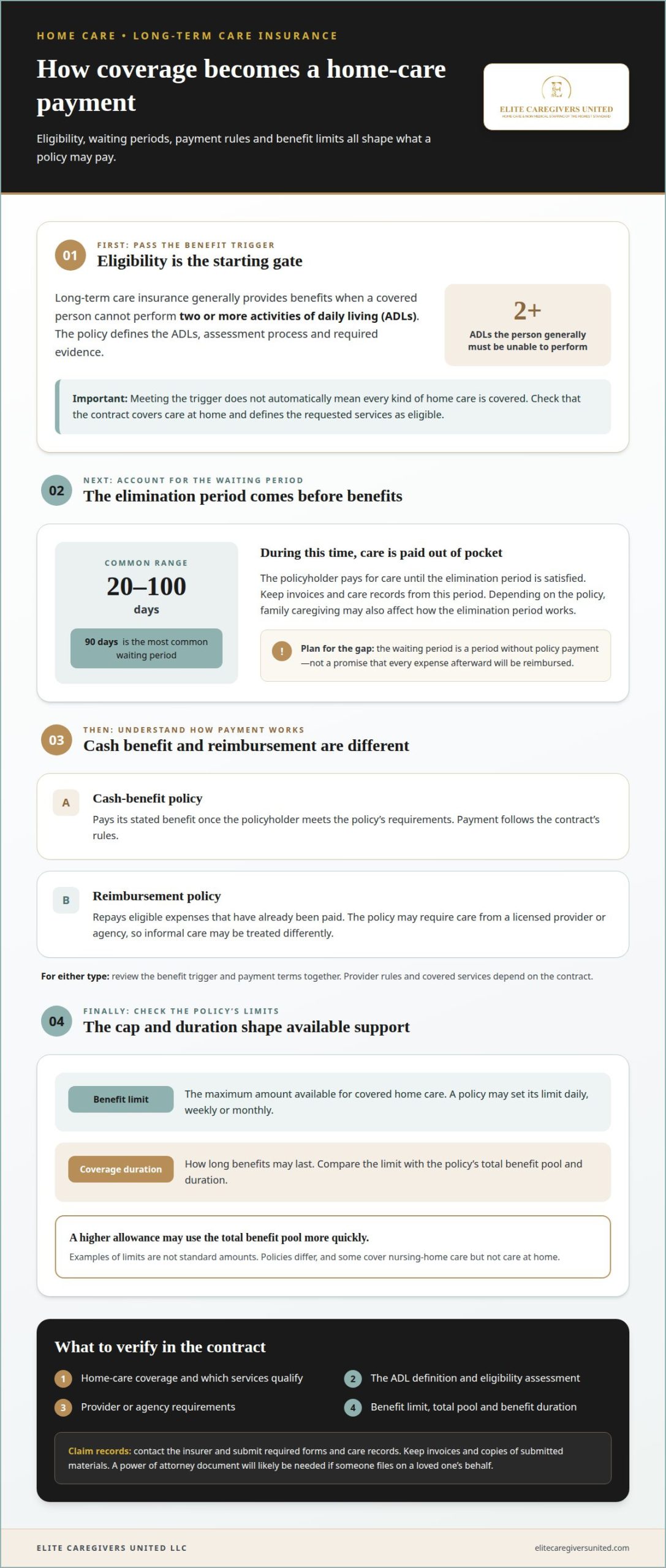
For families paying for home care with long-term care insurance, benefits commonly begin after an elimination period of 20 to 100 days, with 90 days the most common waiting period. During that time, the policyholder pays out of pocket for care. To qualify, a person generally must be unable to perform two or more activities of daily living, and the policy must cover care at home.
It’s understandable to want a clear picture of when support can begin and how much a policy may contribute. This guide explains how eligibility and waiting periods work, how daily, weekly, or monthly benefit limits affect payments, and how Medicare or Medicaid may apply. Understanding the policy details can help your family weigh options as care needs change.
Key Takeaways
- Compare your policy’s home-care coverage and benefit limit, which may be set daily, weekly, or monthly.
- Eligibility commonly depends on being unable to perform two or more activities of daily living, as defined by the policy.
- Plan for an elimination period that commonly ranges from 20 to 100 days, with 90 days the most common; care costs during this time are paid out of pocket.
- People age 65 or older are likely eligible for Medicare, the federal insurance program for older adults, according to the Centers for Medicare & Medicaid Services. Medicare and Medicaid may help with some care, subject to coverage rules and eligibility.
What’s the daily, weekly, or monthly benefit limit?
A policy’s benefit limit sets the maximum amount available for covered home care. Payment method, provider rules, and benefit duration all affect how much support the policyholder can use. For families paying for home care with long-term care insurance, these terms determine how benefits may fit the care plan.
Benefit Limits and Coverage Duration
A benefit limit caps what a policy pays over a stated period, while coverage duration determines how long benefits may last. These are examples, not standard amounts. Compare the limit with the policy’s total benefit pool and duration: a higher allowance may use the pool more quickly. Policies differ, and some cover nursing-home care but not care at home.
Choose an amount by weighing the expected care arrangement against the policy’s limits and duration. Review whether home care is covered, which services qualify, and whether care must come from a licensed provider or agency. Reimbursement policies often require caregivers to work for a licensed provider or agency, so informal care may be treated differently. Depending on the policy, family caregiving may also affect the elimination period.
Cash Benefits and Reimbursement
A cash-benefit policy pays its stated benefit once the policyholder meets its requirements; a reimbursement policy repays eligible expenses already paid. This distinction affects how families arrange care and document expenses. Reimbursement coverage may require an agency or licensed provider, while cash-benefit payments follow the contract’s rules. Read the benefit trigger and payment terms together.
To file a claim, contact the insurer and submit the required forms and care records. If someone files on a loved one’s behalf, a power of attorney document will likely be needed. Keep invoices and records of care received, especially during the elimination period, when the policyholder pays out of pocket. Start by matching the policy’s payment rules to the care arrangement.
Claims may be delayed or denied because eligibility criteria were not met, care is excluded, provider requirements were not followed, or claim materials are incomplete. Insurers are required to explain a denial. Rules can vary by state, so review the policy’s home-care definition, provider requirements, and benefit terms to understand coverage where the policy applies.
TRICARE generally doesn’t cover long-term care, but it covers some home healthcare through a cost-sharing plan for dependents of active military personnel and military retirees. Long-term care policies may cover hospice, depending on the contract. Long-term care insurance generally costs more for older people and people with pre-existing conditions.
Long-term care insurance eligibility and activities of daily living
Eligibility usually depends on a policy’s benefit trigger, the criteria an insurer uses to decide whether someone qualifies. Long-term care insurance generally provides benefits when a covered person cannot perform two or more activities of daily living. Meeting that threshold is central, but it does not automatically mean every type of home care is covered. The policy also defines eligible services, assessment requirements, and any limits on care coverage.
Review the contract’s definition of activities of daily living and how it assesses a person’s ability to perform them. Policies may use different wording or assessment processes, so the same condition can be evaluated differently under separate contracts. A diagnosis alone may not meet the benefit trigger; the insurer needs information related to the policy’s eligibility criteria. Nursing-home and home-care coverage may also have different terms.
For a home-care claim, prepare the insurer’s claim form and records describing the person’s functional limitations. A care plan can outline the assistance needed, the services requested, and how they relate to daily needs. The policy determines which documents are required, so organize your submission around its benefit trigger and definitions. If a family member files for someone else, a power of attorney document will likely be needed.
Keep the assessment, care plan, and claim details consistent. If an assessment describes difficulty with daily activities, for example, the care plan should explain what support is needed at home and why. This links eligibility evidence to the requested services rather than relying on a diagnosis alone. Save copies of submitted forms and insurer communications, and note any requested follow-up materials. Clear records help families understand how the insurer applied the policy’s criteria and what information may still be relevant to its decision.
Medicare and Medicaid as other payment options
Medicare and Medicaid can help with some care needs, but neither generally pays for every form of long-term home care. In the United States, people age 65 or older are likely eligible for Medicare, the federal insurance program for older adults, according to the Centers for Medicare & Medicaid Services. Medicare does not cover most long-term care services. It can cover certain short-term skilled nursing facility care after a hospital stay.
Medicare-covered home healthcare must be part-time and provided by a Medicare-certified agency or an agency meeting federal requirements for care and cost. This coverage differs from ongoing help with daily activities. Someone needing medical home healthcare may qualify under different conditions than someone seeking regular personal assistance at home. Medicare managed care plans must provide the full range of covered home health and hospice services, subject to prior approval.
Medicaid is a joint federal-state medical assistance program for people and families with low incomes. Eligibility and coverage vary by state, so both household income and state rules matter. Medicaid typically covers long-term care at specific facilities after a person qualifies. Federal rules also require Medicaid home health programs to include part-time nursing, healthcare services, and medical supplies and equipment.
If a long-term care insurance policy doesn’t cover a home-care need, Medicare or Medicaid may offer another way to pay, depending on eligibility and the service. Some people pay out of pocket and spend down income and assets until they qualify for Medicaid. This can affect how a family plans for ongoing assistance. Distinguish medical home health coverage from long-term personal support when comparing options: Medicare’s limited home healthcare coverage is not general long-term care coverage. Comparing the care needed with each program’s eligibility and service rules can clarify which expenses may remain the family’s responsibility.
What are typical elimination periods and benefit limits for home care coverage?
An elimination period is the time a policyholder waits before the insurer starts paying eligible home-care benefits. Long-term care policies commonly set this period at 20 to 100 days, and 90 days is the most common waiting period. The exact requirement appears in the policy and affects how families plan for care expenses.
During the elimination period, the policyholder pays out of pocket for care received. Once it ends, the insurer begins paying the policy’s cash benefit or reimbursing eligible expenses already paid. The waiting period is therefore a cash-flow consideration: a family may need to cover care costs before benefits start. Keep records of care and payments throughout the period.
Check how the policy defines a qualifying day and what documentation it requires. The elimination period and benefit limit serve different purposes: one determines when payments can begin, while the other caps the benefit. Review both alongside home-care coverage, the payment method, and the total benefit duration. Together, these terms show how benefits may support care over time.
For example, if a policy requires a 90-day elimination period, the family pays eligible care expenses during that period. Once it ends, the insurer’s payment follows the contract’s benefit rules. A daily, weekly, or monthly cap may still limit what the policy pays, even after benefits begin. Planning around both the wait and the cap can help families anticipate the portion they may need to fund themselves.
To prepare, identify the policy’s elimination-period terms, qualifying care requirements, and claim documentation rules. Then map expected care expenses against the payment limit and benefit duration. Keep invoices and care records together so the insurer can review eligible expenses. For guidance arranging support while you plan around the waiting period, discuss home-care support needs.
Elite Caregivers United: Respite Care
Elite Caregivers United LLC offers Respite Care for families coordinating home-care benefits and ongoing support. Respite can give a family caregiver time to manage other responsibilities while their loved one receives assistance at home. Insurance payment depends on the policy’s terms, so keep the care arrangement and claim records aligned with its requirements.
For daily personal assistance, the Personal Care Services / CNA Team can support routines at home. Surgery Recovery & Post-Hospitalization Care and Cosmetic Surgery Recovery can also help families arrange support after a procedure. These services provide non-medical care.
If your family is balancing caregiving with an insurance claim, consider whether respite or personal care support fits your current needs. Contact Elite Caregivers United LLC to discuss care options.
Make a Care Plan That Works for Your Family
A clear plan for paying for home care with long-term care insurance can help your family connect benefit paperwork with the support needed at home. Keep care priorities, policy requirements, and claim records together to make decisions about daily support more manageable as circumstances change. Your policy and individual situation determine which expenses may qualify for benefits.
When family caregiving becomes difficult to sustain, practical help can support both the person receiving care and their caregivers. Elite Caregivers United LLC offers Respite Care, Personal Care Services / CNA Team support, and Surgery Recovery & Post-Hospitalization Care. These options provide non-medical assistance at home while families manage care responsibilities.
To discuss support that fits your family’s needs, contact Elite Caregivers United LLC. A thoughtful next step can bring greater clarity as you plan care together.
Frequently Asked Questions
What’s the elimination period before my loved one can begin receiving benefits?
Long-term care insurance elimination periods commonly range from 20 to 100 days, with 90 days the most common. The policy explains how the waiting period applies to your loved one’s claim. During it, care expenses are paid out of pocket. Keep invoices and care records together from the beginning, then use them to track expenses and understand when benefits may start under the contract.
Are premiums suspended once the policy is activated?
Starting a claim doesn’t automatically mean premiums stop. The policy’s premium-waiver terms explain whether payments continue or may be waived after the insured person qualifies for benefits. Review that provision alongside the claim trigger and elimination-period terms. This helps your family plan for both premium payments and care expenses instead of assuming that benefits automatically change the premium obligation.
Does Long-Term Care Insurance Cover In-Home Care?
Some long-term care insurance policies cover in-home care, while others cover only nursing-home care. The contract defines which home services qualify and may set conditions for who provides them. Reimbursement policies often require caregivers to work for a licensed provider or agency. Before arranging care, compare the policy’s covered-service wording with the help needed, such as assistance at home or support in a facility.
Does the LTC policy pay a cash benefit, or does it reimburse?
Policies may pay a cash benefit or reimburse eligible expenses, depending on their terms. With reimbursement, the policyholder pays for covered care and submits eligible expenses for repayment. Some reimbursement policies require care from a licensed provider or agency. Cash benefits follow the contract’s rules. Identify the payment method early, since it affects how your family tracks care arrangements and expenses.
How much coverage?
The amount available depends on the policy’s benefit limit, total benefit pool, and coverage duration. A daily, weekly, or monthly cap sets the maximum benefit for that period; the contract also defines which expenses count. Compare these terms with the expected care arrangement and how long support may be needed. The benefit limit is not necessarily the amount the insurer will pay for every service.
What are the policy’s eligibility triggers?
Eligibility triggers are the policy criteria an insurer uses to determine whether someone qualifies for benefits. Long-term care insurance generally provides benefits when a covered person cannot perform two or more activities of daily living. The contract defines those activities and the assessment process. A diagnosis alone doesn’t establish that the trigger is met, so focus on how the policy describes and evaluates functional limitations.