
VA support for home care can include practical help at home, respite care, and skilled home health services. Veteran home care benefits in Florida may also include Aid and Attendance, an additional monthly payment for eligible veterans. According to the U.S. Department of Veterans Affairs, Aid and Attendance eligibility requires at least 90 days of active duty, including at least one day during a VA-defined wartime period.
It’s understandable to want clear answers before arranging care for someone who needs help with daily routines. Eligibility depends on more than military service: the VA also considers financial and medical factors, and available services depend on the Veteran’s needs and circumstances.
This guide explains how to understand eligibility, what kinds of long-term care the VA may offer, and how support at home can work. It also covers what to consider when selecting care, so you can approach the next steps with greater clarity and confidence.
Key Takeaways
- Understand how service history, financial circumstances, and documented care needs factor into an eligibility review.
- Compare home aide support, respite, and skilled home health services, noting that access depends on VA healthcare enrollment and the veteran’s needs.
- Consider caregiver consistency, communication, and experience with veteran-specific programs when planning ongoing support.
- Learn how respite and personal care can support a veteran at home while giving family caregivers room to rest or manage other responsibilities.
How can I check if I am eligible for VA benefits?
First, distinguish eligibility for a monthly pension supplement from access to VA healthcare services. Both may support care planning, but each has its own criteria.
Aid and Attendance Eligibility
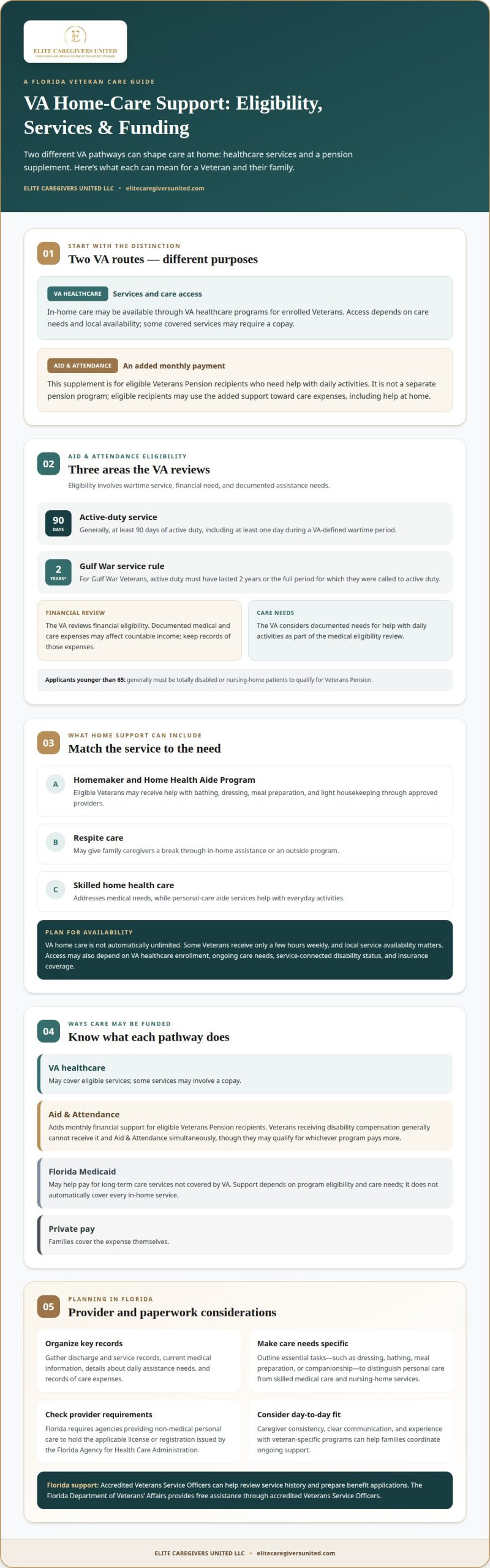
Aid and Attendance is an added monthly payment for eligible Veterans Pension recipients who need help with daily activities. Eligibility depends on wartime service, financial need, and documented assistance needs, so gather service and medical records together. According to the U.S. Department of Veterans Affairs, a U.S. veteran generally needs at least 90 days of active duty, including at least one day during a VA-defined wartime period. For Gulf War veterans, the U.S. Department of Veterans Affairs states that active duty must have lasted 2 years or the full period for which they were called to active duty.
Veterans Pension and Aid and Attendance
Aid and Attendance supplements Veterans Pension; it is not a separate pension program. The VA reviews financial and medical eligibility, including documented care needs, before deciding whether the supplement applies. This distinction matters because medical and care expenses may affect countable income when pension eligibility is assessed. Keep records of those expenses, as they may factor into the financial calculation.
For a practical review, organize discharge and service records, current medical information, and details about daily assistance needs. Applicants younger than 65 generally must be totally disabled or nursing-home patients to qualify for Veterans Pension. VA.gov offers resources for understanding and applying for benefits; accredited representatives can also help applicants prepare at no charge.
VA may provide in-home care through its healthcare programs, and some covered services may require a copay. Aid and Attendance adds monthly financial support that eligible recipients can use toward care expenses, including help at home. Veterans receiving disability compensation generally can’t receive it and Aid and Attendance simultaneously, though they may qualify for whichever program pays more. A disability rating can range from 0% to 100%, based on the condition’s severity.
What kinds of long-term care services does VA offer for sick or disabled Veterans?
VA long-term care ranges from help with daily activities at home to nursing and medical care. The services a Veteran may qualify for depend on VA healthcare enrollment, ongoing care needs, and local availability.
Service-Connected and Needs-Based Benefits
Service-connected benefits relate to disabilities connected to military service, while needs-based programs consider financial circumstances and care requirements. A Veteran’s service history and documented needs can affect which VA services apply. Wartime service can matter for pension-related support, but a combat injury isn’t required for VA home care support. Florida Veterans Service Officers can help review service history and prepare benefit applications.
VA Health Care and Home Care Services
VA healthcare includes long-term care options for enrolled Veterans who need ongoing treatment or personal care. The Homemaker and Home Health Aide Program can connect eligible Veterans with approved providers for help with bathing, dressing, meal preparation, and light housekeeping. These services may help a senior remain more independent at home, while skilled home health care addresses medical needs.
VA home care isn’t automatically unlimited. Some Veterans receive only a few hours weekly, and local service availability matters. Respite care may also give family caregivers a break, through in-home assistance or an outside program. The VA may consider service-connected disability status and insurance coverage when determining access to long-term care.
For Florida Veterans, the Florida Department of Veterans’ Affairs provides free assistance through accredited Veterans Service Officers. A Veteran can bring service records and details about care needs to discuss possible eligibility and application steps. This support can help clarify which benefits are service-connected and which depend on financial need.
VA home care benefits, Florida Medicaid, and private-pay care work differently. VA healthcare may cover eligible services, sometimes with a copay. Medicaid may help pay for long-term care services not covered by VA, while private pay means families cover the expense themselves. Florida Medicaid long-term care support depends on program eligibility and care needs, so it does not automatically cover every in-home service.
When daily personal assistance is needed alongside VA or Medicaid support, CNA-led personal care services can be another part of the home-care plan.
Choosing a home care provider after approval
Approval identifies a benefit, but the daily care plan still needs to fit the Veteran’s condition and routines. In Florida, compare the approved service with the help needed at home, such as dressing, bathing, meal preparation, or companionship. A written outline of essential tasks helps families distinguish personal care from skilled medical care and nursing home services.
Florida requires agencies providing non-medical personal care to hold the applicable license or registration issued by the Florida Agency for Health Care Administration. Caregiver consistency, communication, and experience with veteran-specific programs are also important. For example, a Veteran who needs steady help dressing may benefit from a familiar caregiver and clear updates to family members. These practical details make care arrangements easier to understand and coordinate.
Veteran-focused experience can help care providers understand how military service, health conditions, and VA-supported services shape a family’s planning. Consider whether communication is respectful, routines are recorded clearly, and caregivers share changes in daily needs. A Veteran recovering at home may need a different schedule from someone managing a long-term condition. Benefit eligibility and care preferences are separate matters, so keep benefit paperwork distinct from the day-to-day care plan.
Location matters, too. When searching for veteran home care benefits Florida families trust in the Orlando area, Elite Caregivers United LLC emphasizes practical local factors such as caregiver travel, consistent scheduling, and how updates reach relatives. A nearby arrangement may simplify coordination, while the Veteran’s needs determine the tasks and schedule. Benefit approval alone does not set the care plan: authorized services and the support needed at home are separate considerations.
Before care begins, write down the Veteran’s priorities, daily tasks, preferred communication method, and changes to report. This shared outline gives family members and care providers a clear reference as support begins and needs evolve.
What VA home care benefits are available to veterans in Florida?
In Florida, VA support can combine home-based care services with benefits that help eligible Veterans manage care needs. Access depends on VA healthcare enrollment, assessed needs, and whether the required service is available nearby. These are distinct forms of support, so match each need with the relevant program.
For enrolled Veterans, the VA Homemaker and Home Health Aide Program connects eligible people with approved providers. Assistance may include bathing, dressing, meal preparation, and light housekeeping. Respite care can arrange in-home help or an outside program while a family caregiver takes a break. Skilled home health care addresses medical needs, while personal assistance supports daily routines. Some services covered through standard VA health benefits may require a copay.
For 2026, the maximum Aid and Attendance benefit is $2,424 per month for a single Veteran and $2,874 per month for a married Veteran. These are maximum benefit figures, not automatic payment amounts. Financial eligibility considers countable income, and medical or care expenses can affect that calculation. Certain service-connected disabled Veterans can receive a lifetime HISA grant of $6,800 for disability-related home improvement projects. This grant addresses qualifying home modifications rather than routine caregiver hours.
VA care isn’t a single flat allowance: services and financial benefits work differently. The VA may consider service-connected disability status and insurance coverage when determining access to long-term care. If VA healthcare benefits do not cover a service, Medicaid, Medicare, or private insurance may help pay for some long-term care needs. For example, a family might explore respite support for caregiver relief and a home modification grant for disability-related changes. Separating these needs can make benefit planning clearer.
For assistance with daily personal routines at home, explore personal care services.
Elite Caregivers United: Respite Care
Elite Caregivers United LLC provides Respite Care for families who need support while a family caregiver rests or attends to other responsibilities. This home care helps maintain continuity in a familiar setting, with support shaped around the person’s everyday needs and routines. It can be useful when family care needs to be shared.
For help with daily personal routines, the Personal Care Services/CNA Team offers another form of support. Surgery Recovery & Post-Hospitalization Care and Cosmetic Surgery Recovery can assist during recovery at home. These services are separate from VA eligibility and benefit decisions, so families can consider them as part of their broader care planning. To discuss care options, contact Elite Caregivers United LLC or visit elitecaregiversunited.com.
Shape a Care Plan That Works at Home
Understanding veteran home care benefits in Florida is only part of planning. The next step is to match the Veteran’s support needs with a workable routine, while keeping family responsibilities and personal preferences in view. A written care plan helps everyone understand which daily tasks need attention and how support fits alongside VA services.
For families arranging non-medical help at home, Elite Caregivers United LLC offers Respite Care, Personal Care Services/CNA Team, and Surgery Recovery & Post-Hospitalization Care. These services can support family caregivers, daily personal routines, or recovery after a hospital stay. Choose an arrangement that reflects the Veteran’s needs and the family’s role, without confusing home support with VA eligibility decisions.
When you’re ready to discuss care for your family, contact Elite Caregivers United LLC. A thoughtful next step can make planning feel more manageable and help your loved one receive considerate support at home.
Frequently Asked Questions
Does This Include VA Aid and Attendance Benefits?
Yes, Aid and Attendance is one form of support families may consider when planning veteran home care benefits in Florida. It is a monthly payment for eligible recipients, not a caregiver assignment or direct scheduling of home visits. Families can distinguish the benefit payment from a VA-arranged home health aide service when organizing care and tracking related expenses.
Does VA provide specialized geriatric (elder) care for seniors with multiple physical and mental health needs?
Yes, VA offers Geriatric Patient Aligned Care Team services at about two-thirds of VA medical centers. These teams address older Veterans’ complex health needs through geriatric care. A family supporting someone with both mobility changes and memory concerns can ask about geriatric services available through the Veteran’s VA healthcare setting. VA also identifies being 65 years or older as one example of a geriatric syndrome.
What if I have a disability or chronic (long-term) health condition, but I want to stay in my home?
VA home-based care may support eligible Veterans who need help while living at home. Depending on assessed needs and service availability, support can include assistance with daily tasks or skilled home health care for medical needs. For example, a Veteran managing a long-term condition may need personal assistance at home while continuing treatment through VA healthcare. Home care can help bridge treatment and greater independence.
What if I’m homebound or live far away from VA?
Distance can affect access to VA long-term care services because the required service or a place must be available nearby. Tell the VA healthcare team what makes travel difficult and describe the support needed at home, such as bathing assistance or medical care. The VA may consider service-connected disability status and insurance coverage when determining access to long-term care services.
Who is eligible for VA homemaker, home health aide, and skilled home health care?
Veterans generally need to be enrolled in VA healthcare, need the specific service for ongoing treatment or personal care, and have that service available nearby. For instance, an enrolled Veteran who needs help dressing may be considered for homemaker or home health aide support. Skilled home health care addresses medical needs, and access may also reflect service-connected disability status or insurance coverage.
How do Aid and Attendance and Housebound benefits help pay for home care?
Aid and Attendance can provide eligible recipients with additional monthly financial support, while Housebound status may affect certain benefit payments. For surviving spouses receiving Dependency and Indemnity Compensation, the 2026 monthly addition is $421 for Aid and Attendance, or $197.22 for housebound status. These are distinct provisions, so families should identify which benefit the recipient receives when planning how payments may contribute to care expenses.